

Ensemble Interpretation of Quantum Mechanics, Explained.
Superposition, wavefunction collapse, Schrödinger's Cat, and the statistical perspective to understand quantum theory.

Welcome to Bohring. Here, we look at the universe, life, and science education through a physicist’s lens. If you're new here, consider joining our community of curious minds:
Part 2 in Interpretations of Quantum Mechanics
What does ‘interpretation of quantum mechanics’ mean?
An interpretation of quantum mechanics is a philosophical framework that explains how the maths of quantum physics translates into physical reality. While the quantum math is universally agreed upon and incredibly accurate, interpretations answer the conceptual questions about what is actually happening at the microscopic level.
The central mystery is the measurement problem: when you observe or measure a quantum particle, its wave collapses into a single, definite reality. Interpretations attempt to explain how and why this happens.
The Ensemble Interpretation (EI) (sometimes called the Statistical Interpretation) of quantum mechanics is a very minimalist, down-to-earth conceptual framework for understanding the mathematics of quantum theory.
Copenhagen interpretation (CI) often demands that you accept bizarre physical phenomena like a single particle being in two places at once or wavefunctions collapsing instantaneously across space.
The Statistical Interpretation, pioneered by Max Born, is the broad umbrella focusing on the probabilistic nature of quantum measurements. EI is a specific minimalist view that views quantum mechanics not as a description of a single physical system, but as a description of a large ensemble of identically prepared systems.
What is a State Vector?
In standard textbook quantum mechanics, we are taught that the state vector |ψ⟩ (or the wavefunction ψ(x)) completely describes the physical state of an individual system, such as a single electron.
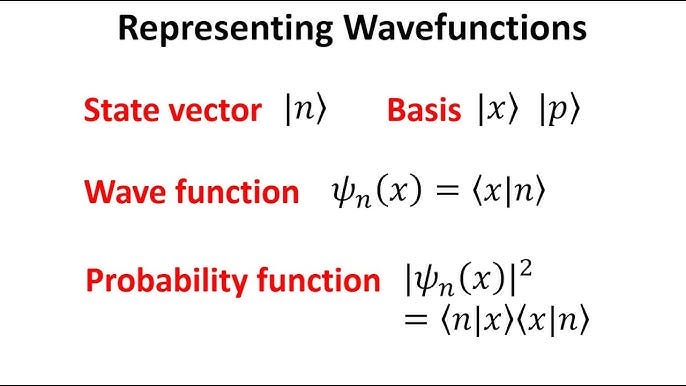
EI flatly rejects this.
According to this view, championed by physicists like Leslie Ballentine, a state vector does not describe an individual, isolated physical system. Instead,
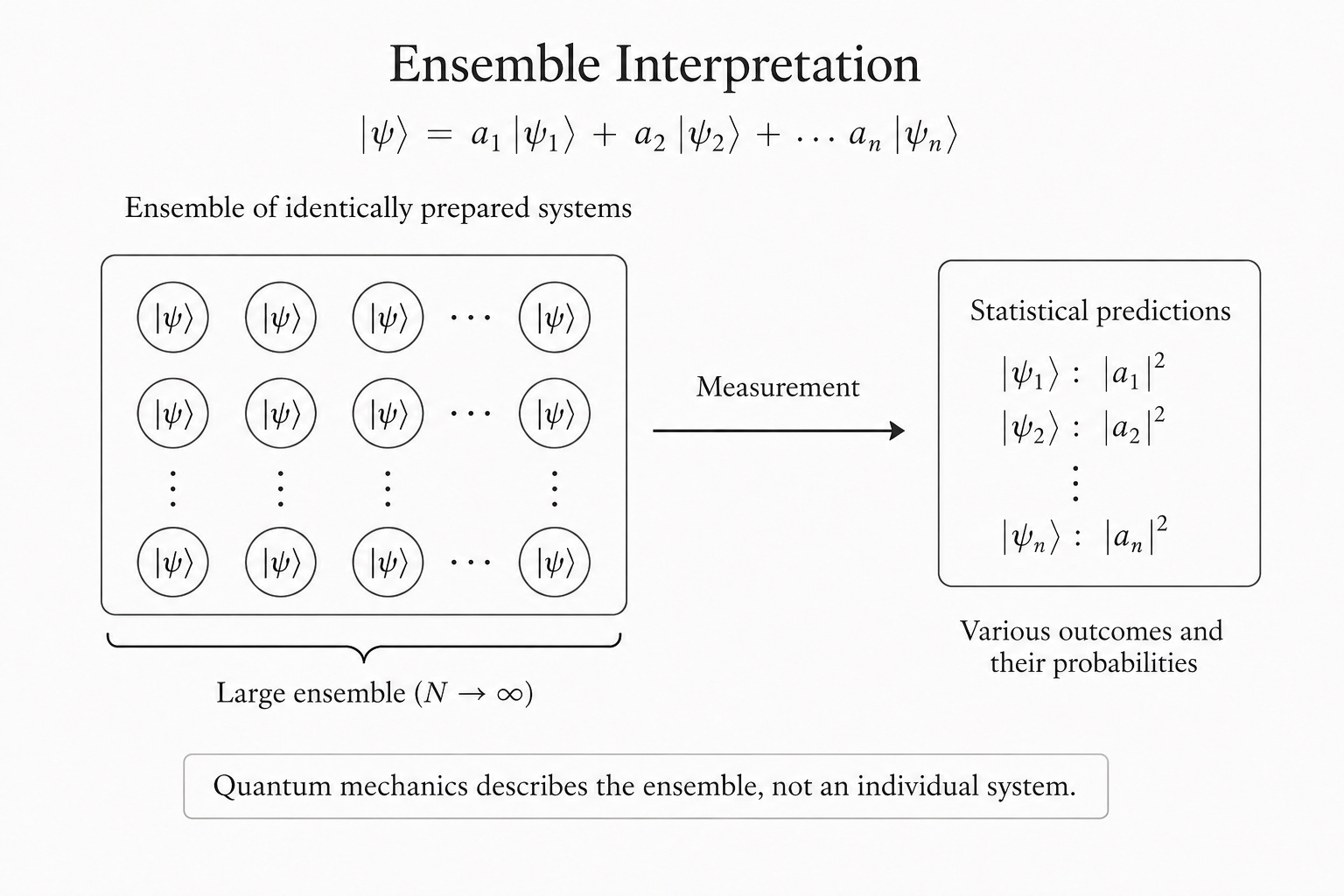
|ψ⟩ describes an ensemble—an infinite collection of independent, identically prepared physical systems.
Think of a standard six-sided die. If I tell you that the probability distribution for rolling this die is biased, such that the probability of rolling a 6 is 50%, this probability does not describe any single roll. Before you roll the die, it is not in a superposition of being a 3 and a 6 simultaneously. The probability distribution is a property of the entire setup—the geometry of the die and the throwing process—and it only reveals itself when you roll the die hundreds or thousands of times.
In EI, the wavefunction works exactly the same way. When we write down the wavefunction of an electron in a hydrogen atom, we are not describing what a single electron is doing right now. We are describing the statistical properties of a vast collection of hydrogen atoms, all prepared in the exact same state.

EI is often regarded as philosophically close to views expressed by Einstein regarding the statistical nature of quantum theory.
Superposition without paradox
If a particle is in a state of quantum superposition:
CI implies that the individual particle somehow occupies both states |A⟩ and |B⟩ at the same time until someone looks at it. EI bypasses this paradox entirely:
Superposition state: The above equation simply means that the state vector encodes the statistical structure of measurement outcomes across an ensemble of similarly prepared systems. If you have an ensemble of N identically prepared systems (where N is very large), measurements performed in the {|A⟩,|B⟩} basis will yield the outcome |A⟩ with probability |α|2 and the outcome |B⟩ with probability |β|2. Consequently, approximately a fraction|α|2 of the ensemble will be found in state |A⟩ and a fraction |β|2 will be found in state |B⟩ when such measurements are carried out.
Probability: The coefficients α and β do not represent a blurry, physical reality for a single particle. They represent the statistical distribution of measurement outcomes across your massive collection of similarly prepared systems.
Resolving Schrödinger’s Cat
In this framework, the infamous Schrödinger’s Cat paradox evaporates. If you set up the experiment with a radioactive atom, a vial of poison, and a cat, the wavefunction of the system is a superposition of a dead cat and a live cat.
CI: The individual cat is literally both alive and dead until the box is opened, forcing a collapse.
EI: The wavefunction describes an ensemble of thousands of identical boxes. In roughly half of those boxes, the cat is fully alive; in the other half, the cat is fully dead. Opening the box does not alter the physical state of the cat; it merely reveals which specific box you are looking at from the larger statistical pool.
Nature of measurement and wavefunction collapse
In standard quantum mechanics, the measurement problem is notoriously difficult. It introduces wavefunction collapse (|ψ⟩ → |A⟩), which is a non-unitary, discontinuous change in the state of the system that seems to happen faster than the speed of light.
In case you’re unfamiliar,
Non-unitary means the transformation is irreversible and does not preserve total probability. In contrast, standard quantum evolution under the Schrödinger equation is unitary—meaning it is deterministic, reversible, and keeps the total probability strictly at 1.
For mathematically inclined readers:
If a time-evolution operator U is unitary, it satisfies U†U = I. This ensures that the inner product of the state with itself remains constant:
When a measurement causes a non-unitary collapse, the state is abruptly projected into a specific eigenstate. Because this process ‘throws away’ the other possible states, it cannot be described by a smooth, unitary matrix operation, making it mathematically irreversible.
EI handles measurement beautifully by reclassifying it as a purely mathematical update of information. When you measure a quantum system and get a specific result, the wavefunction does not physically collapse. Instead, your measurement acts as a selection process. You are simply focusing your attention on a subset of the original ensemble.
To see this clearly, imagine an ensemble of particles prepared in a state with various possible velocities. If you place a detector that only triggers for particles moving faster than a certain threshold, you are not physically altering the wavefunctions of the other particles. You are choosing to study a new sub-ensemble consisting only of the fast-moving particles.
The change in the wavefunction is identical to changing your probability calculations in classical statistics when you gain new information (conditional probability). It is a change in the physicist’s ledger, not a physical explosion or a magical transformation of the particle itself.
Uncertainty Principle reinterpreted
Heisenberg’s Uncertainty Principle is often taught as an intrinsic restriction on nature, or a disturbance caused by the act of measurement: if you measure a particle’s position too accurately, you kick it, blurring its momentum.
EI offers a completely clean, statistical reading of this formula:
The uncertainty relation itself places constraints on the statistical distributions obtained from an ensemble of measurements. Whether an individual particle possesses simultaneous definite values of position and momentum is a separate ontological question that the Ensemble Interpretation does not attempt to answer.
What the uncertainty principle does say is that if you prepare a large ensemble of identically prepared particles, measure the positions of one subset and the momenta of another subset, the resulting standard deviations (Δx) and (Δp) must satisfy the inequality. In this view, the uncertainty principle is fundamentally a statement about the statistical spread of measurement outcomes across an ensemble, rather than a direct statement about the properties of any single particle. It is therefore a property of the preparation procedure of the quantum state, not a limitation of our measurement tools or a statement that nature itself is physically blurry.
Some historical context
To truly grasp EI, it helps to understand why it was advocated. Albert Einstein was deeply dissatisfied with the Copenhagen interpretation’s reliance on observer-created reality and randomness. In his view, quantum mechanics was a brilliant theory, but it was incomplete.
Einstein argued that quantum mechanics is to a true theory of nature what classical thermodynamics is to statistical mechanics. Thermodynamics gives you macroscopic laws (like pressure and temperature) based on averages, but it doesn’t track individual molecules. Similarly, Einstein believed quantum mechanics provides the correct statistical averages for groups of particles, but fails to provide a complete description of the deterministic path of an individual particle.
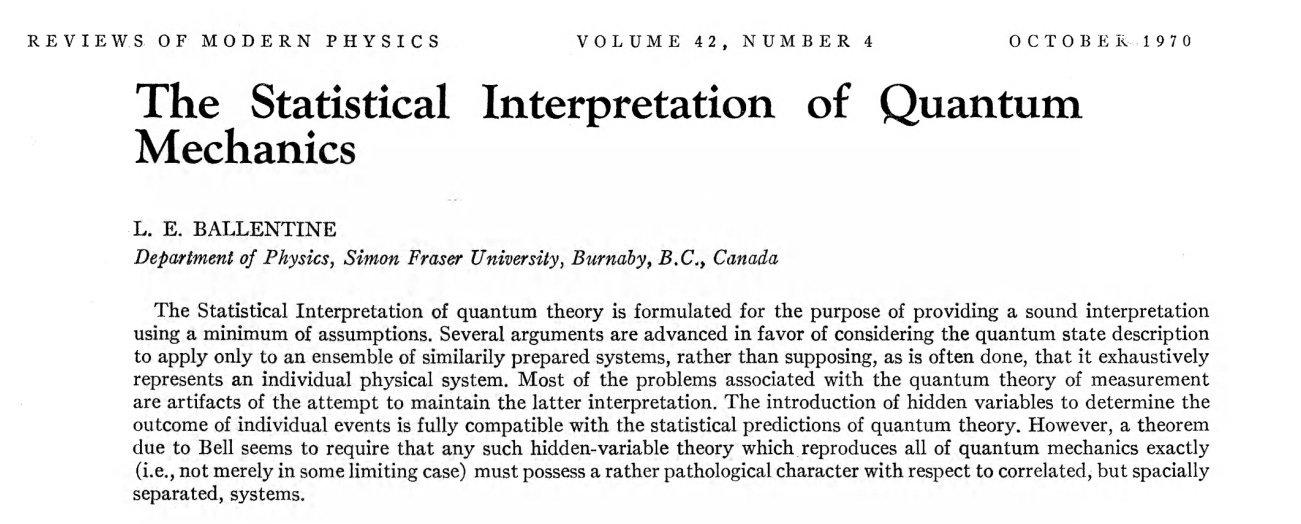
In 1970, Leslie Ballentine modernized this view in his seminal paper “The Statistical Interpretation of Quantum Mechanics.” Ballentine showed that you can derive and utilize all the mathematical machinery of quantum mechanics (the Schrödinger equation, Born’s rule, expectation values) without ever assuming that the wavefunction applies to a single system. By abandoning that assumption, you eliminate almost all the philosophical paradoxes that plague the theory.
Bohring is entirely reader-supported. The deep-dive physics series and philosophical essays are made possible by the “Deep Divers”—the paid community members who value independent science communication.
If you’re currently on the free tier, consider upgrading to a paid subscription to unlock exclusive deep dives, archives, and chat:
Why isn’t everyone an Ensemblist?
While EI is elegant and cleanly avoids metaphysical headaches, it is not without criticism. It achieves its simplicity by being deliberately agnostic about what is actually happening at the microscopic level, which leaves several questions open.
What about individual systems?
The primary criticism of EI is that it refuses to say anything about a single particle. If a scientist isolates a single electron in a Penning trap and holds it there for weeks, observing its properties, that electron exists. It has a real, physical presence. If the wavefunction only describes an ensemble of such traps, what describes that specific electron inside the trap right now? The Ensemble Interpretation simply answers that quantum mechanics is not equipped to answer that question, which many physicists find unsatisfying.
In the early days of quantum mechanics, physicists could only run experiments on bulk matter (beams of millions of atoms). Today, we routinely manipulate individual qubits in quantum computers, individual ions, and single photons.
When we observe quantum jumps in a single trapped ion, or execute an error-correcting algorithm on a specific set of superconducting qubits, treating the state vector purely as an average over an infinite conceptual ensemble can feel detached from lab reality. While the statistical predictions still hold true when the experiment is repeated, the interpretation offers little insight into the real-time dynamics of the single system currently sitting on the laboratory chip.
Bell’s Theorem and Hidden Variables
Because EI suggests that particles might have definite values (like position and momentum) that quantum mechanics simply fails to predict, it naturally leans toward a “hidden variable” philosophy. However, Bell’s Theorem proved that any local hidden variable theory is incompatible with the predictions of quantum mechanics.
Therefore, if an Ensemblist wants to believe that individual particles have definite pre-existing properties before measurement, they must accept that nature is fundamentally non-local (actions here can instantaneously affect outcomes there), or they must abandon the idea that those properties exist at all until measured—which brings them right back to the edge of the Copenhagen view they were trying to escape.
A summary
The Ensemble Interpretation transforms quantum mechanics from a bizarre, mystical story about a single particle being in multiple places at once into a clean, rigorous theory of statistical ensembles.
It demands no physical wave collapse, no observer-dependent reality, and no dead-and-alive cats.
It simply accepts that the state vector is an operational tool designed to predict the outcomes of repeated experiments.
Its strength is its flawless immunity to philosophical paradox.
Its weakness is its silence on the physical reality of the individual quantum system.
Thank you for reading. If my reflections on life or physics resonated with you today and you’d like to support my independent writing without committing to a monthly subscription, you can drop a small tip in my digital jar. It keeps me motivated.
Next Time…
We will discuss the de Broglie–Bohm theory (often called pilot-wave theory).
You Can Also Read:
