

India’s education system has turned on its own students
From paper leeks to marking errors, a sneak peak at India's current education landscape.

Welcome to Bohring. Here, we look at the universe, life, and science education through a physicist’s lens. If you're new here, consider joining our community of curious minds:
Welcome to ‘Vishwaguru’ India, the world’s largest democracy!
Today, I want to tell you about the absolute circus that has been going on these days in my country’s education landscape. If you’ve been keeping up with the news, you know what I’m going to talk about.
Heartbreaking structural failures.
Bizarre media comments.
Dark, accidental comedy.
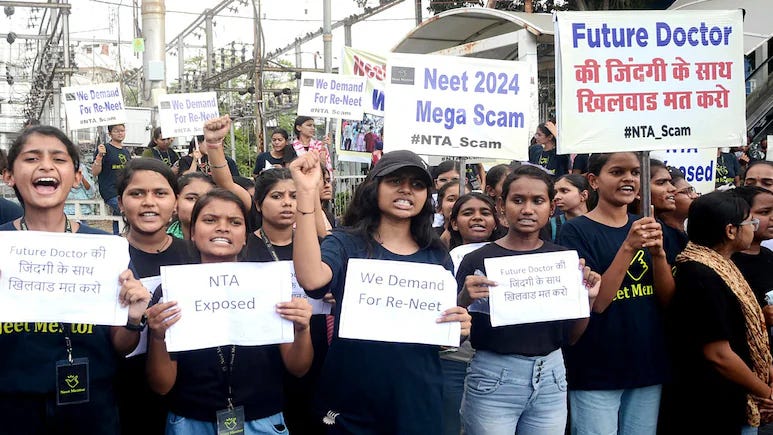
Paper leak is the new normal
In recent years, India’s most prestigious and high-stakes competitive examinations—most notably the National Eligibility cum Entrance Test (NEET) for medical aspirants, alongside several state-level recruitment exams—have been plagued by massive paper leak scandals. Investigations have uncovered organized paper-leak mafias selling questions for lakhs of rupees, leading to cancellations, legal battles, and absolute chaos for millions of students.
Think about it:
You prepare for a competitive exam for a whole year.
You skip family functions and hanging out with friends. In short, you sacrifice your mental health.
The paper leaks.
The exam gets cancelled or dragged into a five-year court case.
Maybe this is exactly what the government wanted.
No exams → No results → No demand for jobs.
Unemployment magically solved! How the government felt after discovering this:
Students labelled anti-national
The way this machinery handles criticism from actual teenagers is arguably the most desperate, diseased part of the entire saga.
Look at what happened to Vedant Shrivastava. The kid gets his CBSE Physics paper back, realizes the board literally scanned and uploaded someone else’s handwriting under his roll number, and speaks out online about the On-Screen Marking (OSM) error.
Instead of the board saying, “Our digital system glitched; let us fix that,” the hyper-nationalist defense brigade labeled him a Pakistani agent! Deep-state agent! Soros operative! Anti-national! Imagine working your butt off for your board exams, getting completely screwed by an administrative screw-up, and being branded a traitor just for wanting your actual marks.
He is just a kid. A kid! Students are working their butt off for their board exams, fighting for their future, and we call them traitors? How diseased does a mind have to be to think like that?
It paints a truly hilarious yet dystopian mental image. Picture a 17-year-old kid in a school uniform, struggling with calculus and living on instant noodles, sitting under a blanket at 2 AM, secretly plotting to overthrow the state by... demanding better grade-mark policies from a school board.
If a nuclear-armed nation feels so threatened by a bunch of stressed-out, sleep-deprived teenagers asking for basic transparency that it has to brand them as national security threats, I’d only say one thing:
In case you don’t understand Hindi, he’s saying: "Stop thinking the public is stupid. No one can digest such childish talk; people make fun of it."
Bohring is entirely reader-supported. The deep-dive physics series and philosophical essays are made possible by the “Deep Divers”—the paid community members who value independent science communication.
If you’re currently on the free tier, consider upgrading to a paid subscription to unlock exclusive deep dives, archives, and chat:
Teachers are worth “Do Kaudi”
During a heated prime-time television debate on these systemic exam failures, senior news anchor Anjana Om Modi Kashyap sparked massive national outrage by lashing out at popular YouTube educators. Dismissing their credentials and their efforts to call out the leaks, she publicly labeled them "do kaudi ke teachers" (two-bit, worthless educators), claiming they were merely staging drama to exploit vulnerable students for views and money.
This comment triggered a massive war between mainstream TV media and the digital education community. Huge online icons—like Khan Sir, Alakh Pandey (PhysicsWallah), and Abhinay Maths—alongside millions of students from small towns, strongly revolted, pointing out that online teachers democratized education for families who could never afford elite, offline coaching centers.
You can watch the following video by turning on the auto-translated English titles:
The reality of this “elite-tier meltdown” is peak irony.
These mainstream Godi media anchors literally thrive on high-decibel yelling matches, biased narratives, and actual daily drama. And here they are accusing others of chasing views while trivializing a crisis affecting millions!
Those “two-bit” YouTube educators were actually doing the heavy lifting because the formal education system is failing. Sitting in cramped rooms with cheap digital whiteboards, they have been explaining complex organic chemistry to kids in remote villages who lack consistent electricity, let alone the ₹2 lakh required for corporate coaching institutes. For millions of students across small-town India, these online creators are the only reason they can afford to dream of passing NEET, JEE, or UPSC. But when they call out systemic issues, they are dismissed as view-hungry businessmen.
These educators are quietly producing the nation’s future doctors, engineers, and—irony of ironies—the very media professionals now insulting them on live TV. Talk about a bad return on investment.
CBSE’s institutional damage control
This is the most embarrassing act of the whole circus. Amidst the growing outcry over mixed-up papers and broken marking systems, the CBSE reportedly dispatched a literal social media ‘toolkit’ titled “Material for Principals” to hundreds of schools, including government-run Kendriya Vidyalayas. The document contained ready-made, copy-pasted scripts commanding highly educated school heads to go online and defend the On-Screen Marking (OSM) system.
What followed was pure comedy, triggering a massive wave of internet memes mocking the “centralized scriptwriter.” Suddenly, social media was flooded with videos of school principals parroting the exact same corporate jargon. Dozens of institutional leaders were caught on camera visibly reading from teleprompters, stumbling over their words, and robotically declaring that the board is “highly proactive, empathetic, and communicative.”
This video is in Hindi, but the section where school principals defend OSM is in English:
The heads of educational institutions are supposed to teach children about independent thought, honesty, and leadership. But here they sit in front of webcams reading a state-sponsored PR script. This is deeply depressing.
All this proves that the institutions we trust to build the minds of tomorrow are run by people who aren’t even allowed to use their own minds today. They turned school leaders into a copy-paste PR wing, all just to protect a fragile bureaucratic ego.
A Vishwaguru Paradox
We proudly call ourselves the Vishwaguru—the teacher of the world—and celebrate being the world’s largest democracy. But a real teacher actually listens to the students when they point out that the textbook is missing pages. A real democracy doesn’t hand out identical scripts to its educators to cover up its administrative blunders, nor does it deploy internet trolls to brand teenagers as national security threats for wanting their actual exam marks.
The current state of our education system is pathetic. But who cares? At least the television ratings are up, and the ‘problem’ of unemployment is being magically solved—one cancelled exam at a time.
Completely normal, right?
Welcome to New India. Study, shut up, and dream.
Thank you for reading. If my reflections on life or physics resonated with you today and you’d like to support my independent writing without committing to a monthly subscription, you can drop a small tip in my digital jar. It keeps me motivated.
You Can Also read:
