

Logarithms, explained simply: A complete guide from algebra to calculus
From astronomy to subatomic world, understand why this elegant mathematical tool governs human perception.

Welcome to Bohring. Here, we look at the universe, life, and science education through a physicist’s lens. If you’re new here, consider joining our community of curious minds:
Part 2 in Great Equations
Logarithms compress massive, unwieldy numbers into manageable scales and solve for unknown time or growth rates.
Exponents ask the question,
“What do I get if I multiply this number by itself a certain number of times?”
Logarithms ask the opposite question:
“How many times do I need to multiply this number by itself to get the result I’m looking for?”
In short, logarithms find the missing exponent.
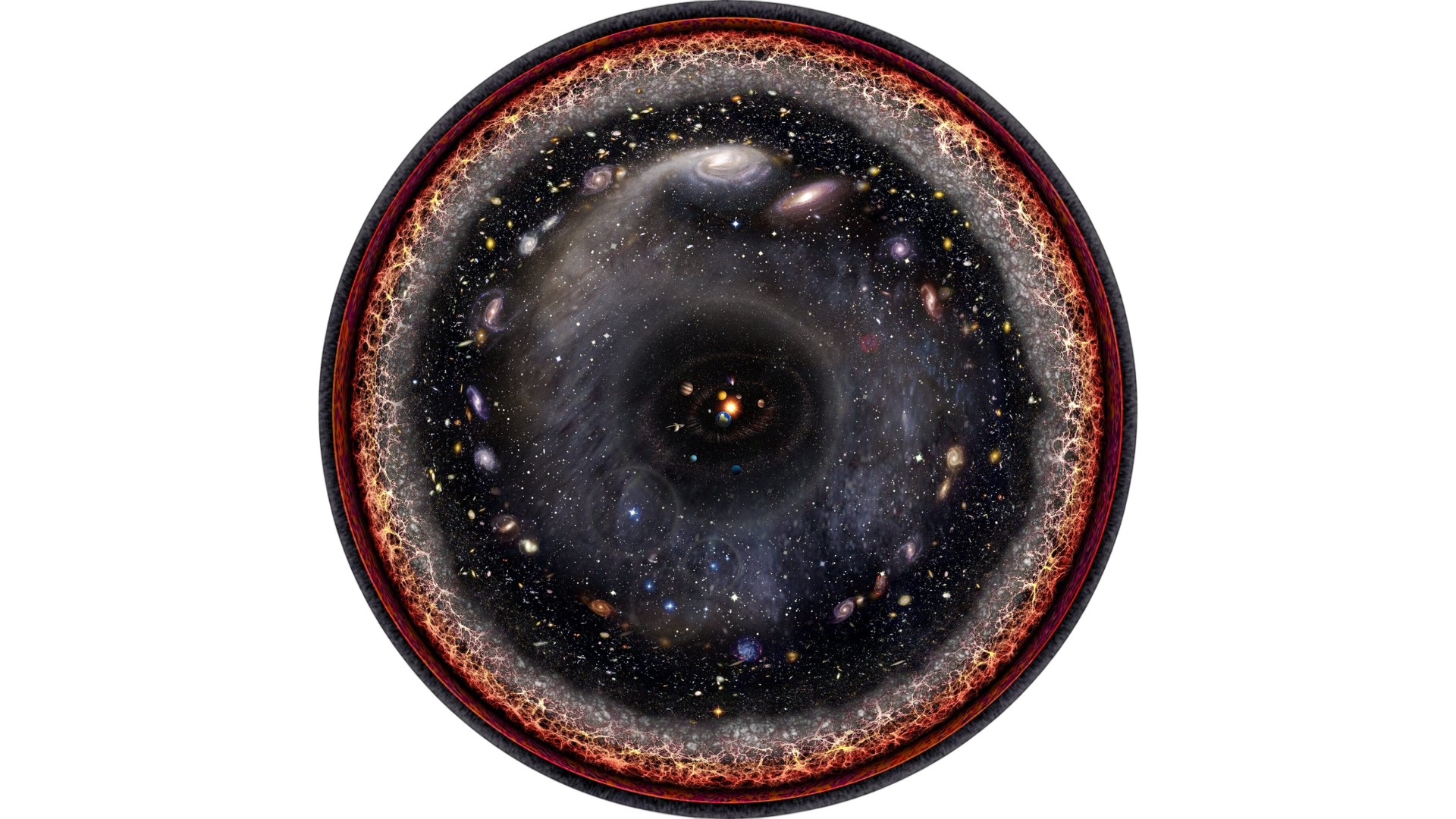
They turn multiplication into counting
Imagine you are looking at a simple geometric progression, like powers of 2. You start with 1, and you keep doubling it:
1
2 (= 2 × 1)
4 (= 2 × 2)
8 (= 2 × 2 × 2)
16 (= 2 × 2 × 2 × 2)
If I ask you, “What is 24?”, your brain does the multiplication and says “16.” That is exponentiation. But what if I ask you, “To what power must I raise 2 to get 16?” You have to count how many times 2 was multiplied. The answer is 4. That counting process is a logarithm.
Mathematically, we write this relationship as:
Where:
b is the base (the number you are repeatedly multiplying).
x is the argument (the final result you are trying to reach).
y is the exponent (the power you must raise the base to).
So, log2(16) = 4 reads aloud as: “The log, base 2, of 16 is 4.” It means you need 4 copies of 2 multiplied together to hit 16. For logarithms to make sense in the real numbers, we have strict rules for the base (b) and the argument (x):
The base b must be positive (b > 0) and cannot equal 1. If the base were 1, 1y would always be 1, making it impossible to reach any other number. If the base were negative, raising it to fractional powers (like 1/2, which is a square root) would push us into imaginary numbers.
The argument x must be strictly positive (x > 0). There is no real power you can raise a positive base to that will result in a negative number or zero.
Universal Bases
While you can technically use any valid number as a base, the mathematical and physical worlds have consolidated around three foundational bases.
Binary Logarithm (log2)
It is used in computer science and information theory. Because computer memory is built on binary states (bits that are either 0 or 1), the binary log tells us how many times we can split a dataset in half. For instance, if you are searching through a sorted list of 1,024 items using a binary search algorithm, it will take at most log2(1024) = 10 steps to find your target.
Common Logarithm (log10)
This is our everyday scale, driven by the fact that humans have ten fingers and use a base-10 numbering system. When you see log(x) written without a base in a standard algebra textbook, it usually implies base 10. Every time a common log increases by 1, the actual value multiplies by 10. It compresses massive cosmic or microscopic scales into numbers we can easily grasp.
Natural Logarithm (ln)
This is frequently used in calculus and higher-level physics. It uses the irrational, transcendental number ‘e’ as its base (e ≈ 2.718281828). Instead of tracking rigid steps of doubling or tripling, the natural log tracks continuous, organic growth.
If you want to know how long it takes a population, an investment, or a radioactive isotope to reach a certain size under continuous change, you use ln(x). The notation ln stands for logarithme naturel.
💻 A note for my free community:
Below, I move shift from what a logarithm is to what it can actually do for us.In the rest of this premium deep dive for paid community members, I discuss:
Logarithmic laws: product rule, quotient rule, power law, change of base formula.
How to visualize logarithms.
Real world applications: chemistry, seismology, acoustics and more.
Logarithm of complex numbers
To unlock the rest of the deep-dive: consider upgrading to a paid membership.