

Max Planck’s 1901 Paper Explained: The Birth of Quantum Mechanics
How a desperate mathematical trick to solve black-body radiation accidentally launched the quantum revolution.

Welcome to Bohring. Here, we look at the universe, life, and science education through a physicist’s lens. If you’re new here, consider joining our community of curious minds:
Part 4 in First Principles
By the late 1800s, physicists felt they had the universe pretty much figured out. Isaac Newton’s laws governed motion, and James Clerk Maxwell’s equations perfectly explained light as continuous waves. There was just one pesky, glowing problem that classical physics couldn’t solve: black-body radiation.
What is a “Black Body”?
Imagine an iron poker thrust into a blacksmith’s forge. As it heats up, it first glows a dull red, then a bright yellow-orange, and eventually a brilliant bluish-white.

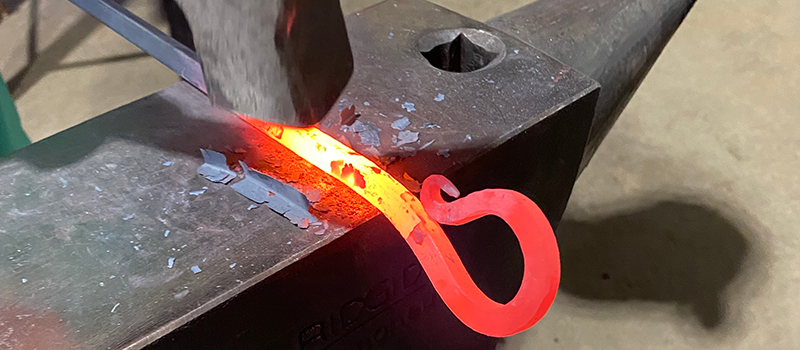
In physics, a blackbody is an idealized object that absorbs all radiation falling on it. Because it reflects no light, it appears perfectly black when cold. However, when heated, it emits a smooth spectrum of light across various wavelengths based only on its temperature.
For years, scientists scrambled to find a mathematical formula that could predict exactly how much energy is radiated at each wavelength for a given temperature. Wilhelm Wien came up with a brilliant formula—Wien’s Distribution Law—derived from molecular-kinetic and electromagnetic theories. It accurately predicted the behavior of high-frequency light (like ultraviolet rays).
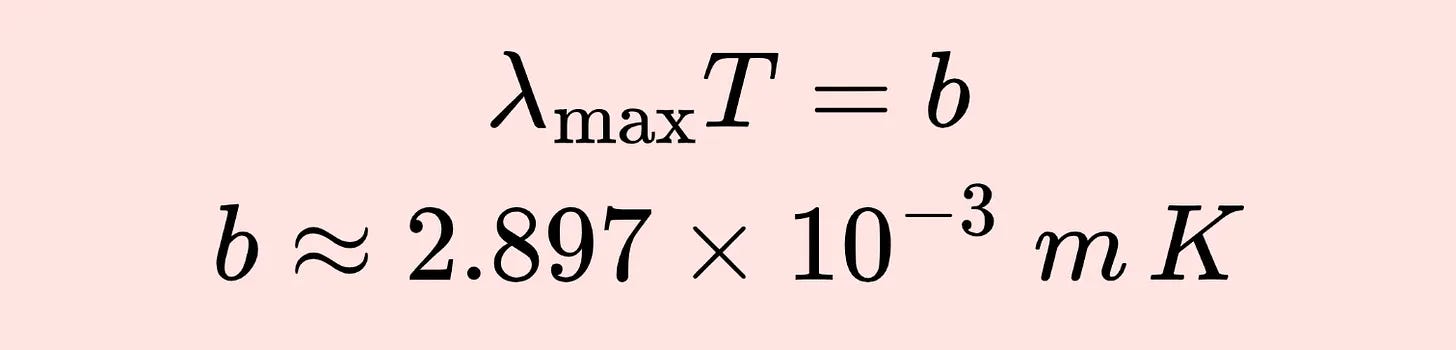
But in the late 1900s, experimental physicists like O. Lummer, E. Pringsheim, H. Rubens, and F. Kurlbaum built revolutionary ultra-precise laboratory setups capable of measuring the longer wavelengths of radiation—the infrared spectrum.
The results were a shock to the scientific community: Energy distribution yielded from Wien’s law completely fell apart in the infrared region. Classical physics was broken.
In this post, I’ll be breaking down his seminal 1801 paper that accidentally changed the course of physics.
An act of sheer desperation
This is where Max Planck enters the story. Planck didn’t set out to completely dismantle classical physics, nor was he trying to spark a quantum revolution. He was a deeply conservative, traditional physicist who respected the established laws of thermodynamics.
However, faced with the undeniable experimental data from his peers, Planck realized that a minor tweak wouldn’t cut it. The theory required a major correction. He later described his work during this period as an “act of desperation.” He was willing to sacrifice any of his cherished classical physics beliefs, save for the two laws of thermodynamics, just to make the mathematical theory align with reality.
Planck’s 1901 paper, “On the Law of Distribution of Energy in the Normal Spectrum” is the historic record of that desperate rescue mission—a paper that accidentally changed the course of science forever.
First, he had to redefine entropy
To fix the broken radiation law, Planck knew he had to dig into the deepest physics of the material world. But there was a catch: in 1900, scientists didn’t yet fully understand the structure of atoms. To get around this, Planck created a simplified, idealized model of matter.
Planck imagined that the walls of his glowing black-body cavity were lined with countless tiny, identical structures he called “monochromatic vibrating resonators”.
Think of these resonators as microscopic atomic springs. Each spring was tuned to vibrate at one specific frequency. When light waves hit these springs, they absorbed the energy and began to vibrate. As they vibrated, they also shook energy back out as electromagnetic radiation.
Planck realized that if he could figure out exactly how much thermal energy these springs held, he could calculate the exact energy density of the light they emitted. Mathematically, the entire problem boiled down to finding a relationship between the energy (U) of a single resonator and its entropy (S).
In his earlier attempts, Planck tried to define entropy purely through classical electromagnetism, believing it would naturally lead to Wien’s law. When experiments proved Wien’s law wrong, Planck had to face a hard truth: his fundamental assumptions about how entropy worked were incorrect.
In a move born out of his self-described desperation, Planck turned to a tool he had long been skeptical of—the statistical mechanics of his rival, Ludwig Boltzmann.
Boltzmann had proposed a radical way to think about entropy. Instead of viewing it as a mysterious, abstract thermodynamic property, Boltzmann tied it directly to disorder and probability. Planck adopted this definition, writing down the now-famous relation:
where
SN is the total entropy of the system of resonators.
k is a universal constant (which we now call Boltzmann’s constant).
W is the probability—essentially, the number of different ways you can distribute a fixed amount of energy across all those atomic springs.
Boltzmann’s “complexes”
To make sense of W, Planck used Boltzmann’s concept of a “complex”.
Imagine you have 10 identical atomic springs and a total pool of energy to distribute among them. If you dump all the energy into just the first spring and leave the other nine completely still, that is one specific configuration—one “complex”. If you distribute the energy evenly so every spring gets a little bit, that represents a vast number of different orderings and arrangements.
Classical physics assumed that energy could be sliced up into infinitely small, perfectly smooth fractions, meaning there should be an infinite number of ways to distribute it. However, to calculate a clean, finite probability (W) for his equations, Planck needed a way to cleanly count these configurations.
This counting problem forced Planck into making the most radical, rule-breaking assumption in the history of science.
Planck chops energy into pieces
Imagine you have a bucket of water (representing continuous energy) and you want to distribute it among 10 empty glasses (the resonators). Because the water is a smooth liquid, you can pour a continuous, varying stream into each glass. There are infinite, microscopic variations in how much water each glass can hold. Frustrated by the mathematical dead ends this caused, Planck made a radical choice. He froze the water.
Instead of pouring a liquid stream, he turned the energy into a bucket of identical, solid ice cubes. He called each individual ice cube an “energy element” and represented it with the Greek letter epsilon (ε).
Now, instead of infinite pouring options, he had a concrete counting problem. If he had 100 ice cubes (P = 100) and 10 glasses (N = 10), he could cleanly calculate every possible configuration —such as giving 7 cubes to the first glass, 38 to the second, and 0 to the fourth. By forcing energy to be a discrete, countable quantity composed of an integral number of finite, equal parts, the math suddenly worked beautifully. He expressed this total energy pool simply as:
where P is a large whole number.
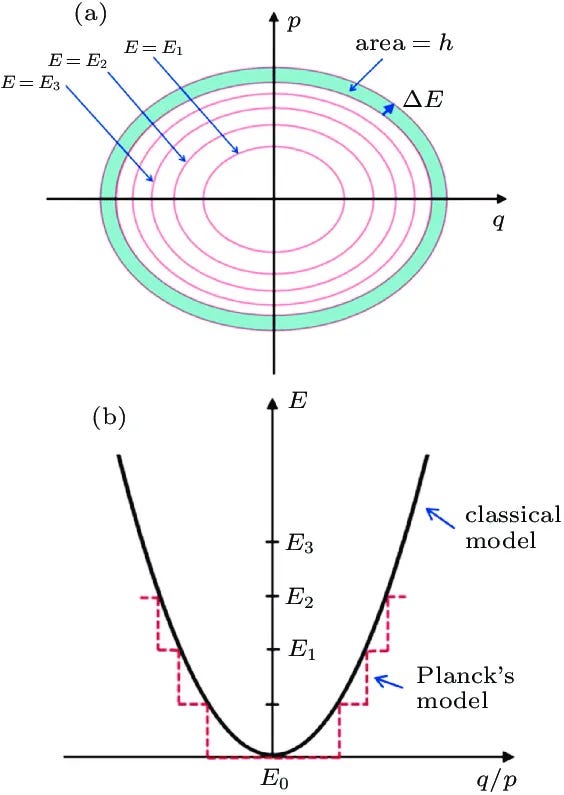

Today, we look back at this moment as the birth of quantum mechanics. The word “quantum” comes from the Latin word for “how much,” referencing these exact energy bundles.
However, it is vital to remember Planck’s mindset at the time. He did not believe that nature actually functioned like ice cubes. He didn’t think energy was truly divided into discrete packets in the real world. To him, chopping energy into finite elements was purely a mathematical trick. A temporary hack to make his probability calculations possible so he could match the experimental data.
Little did he know, he had just stumbled upon the fundamental truth of how our universe operates at the atomic scale.
💻 A note for my free community:
Beyond the concepts, Planck had to prove this worked in the real world. In the rest of this premium deep dive for paid community members, I discuss the technical formalism of his 1901 paper to uncover:
How the math forced Planck to link the size of an energy packet directly to its color.
Combining high and low frequency regimes.
How Planck calculated the fundamental constants of our universe (h and k) to a 1% accuracy using little more than specialized ovens.
To unlock the mathematical breakdown, support independent physics writing, and access the full archive of weekly deep dives, consider upgrading to a paid membership.