Explained: "On a General Method in Dynamics" by William Hamilton
A deep-dive guide to the 100-page masterpiece that reduced the universe to a single function.

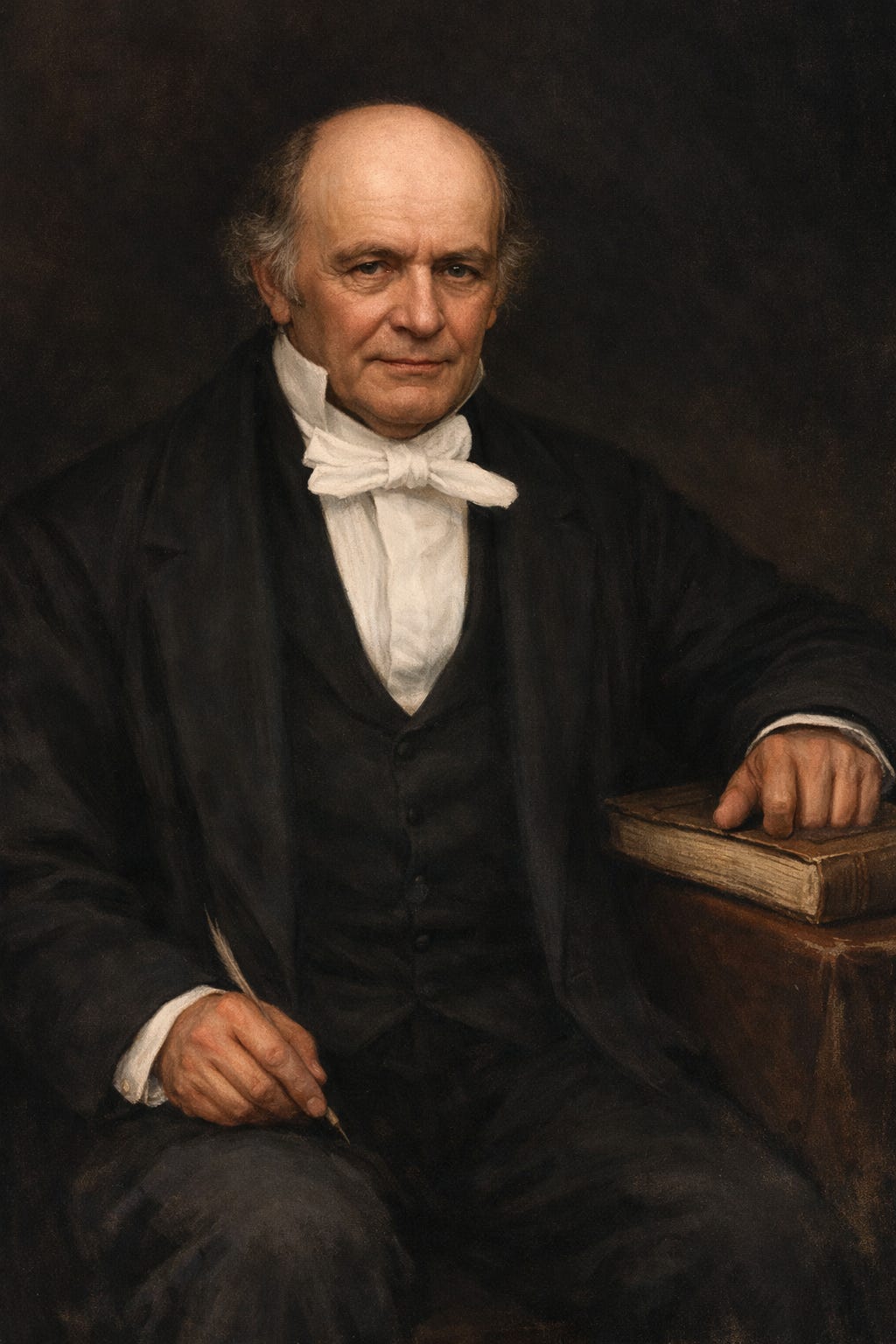
In 1834-35, in two essays collectively titled “On a General Method in Dynamics”, Irish mathematician and physicist Sir William Rowan Hamilton laid out an elegant approach following which the motion of a system could be derived from a single mathematical function.
Please find the original papers here: https://archive.org/details/ongeneralmethodi00hami/page/248/mode/2up
Note: The terminology and notations of his time are somwhat different from what you’d find in a modern textbook. To avoid confusion, I will use his original terms and phrasings, mention them in "quotes" and will explain what they mean in today's language as we go.
The papers are over 100 pages long and filled with dense calculations. Don’t let that intimidate you. You don’t need to worry about every single derivation. We will just focus on the main expressions.
Historical Background
In 1687, Isaac Newton published the equations of motion in his foundational work, Philosophiæ Naturalis Principia Mathematica.
But his approach was not the most elegant one. His physics was a collection of separate rules for separate things. If you wanted to calculate the path of a falling apple, you used one set of equations; for the moon, another. A century later, in 1788-89, Joseph-Louis Lagrange published his foundational work, Mécanique analytique. He provided a generalized framework using which we can derive the appropriate equations of motion of different systems. He introduced the quantity:
where L is now called Lagrangian, T and V are the kinetic and potential energy of the system, respectively.
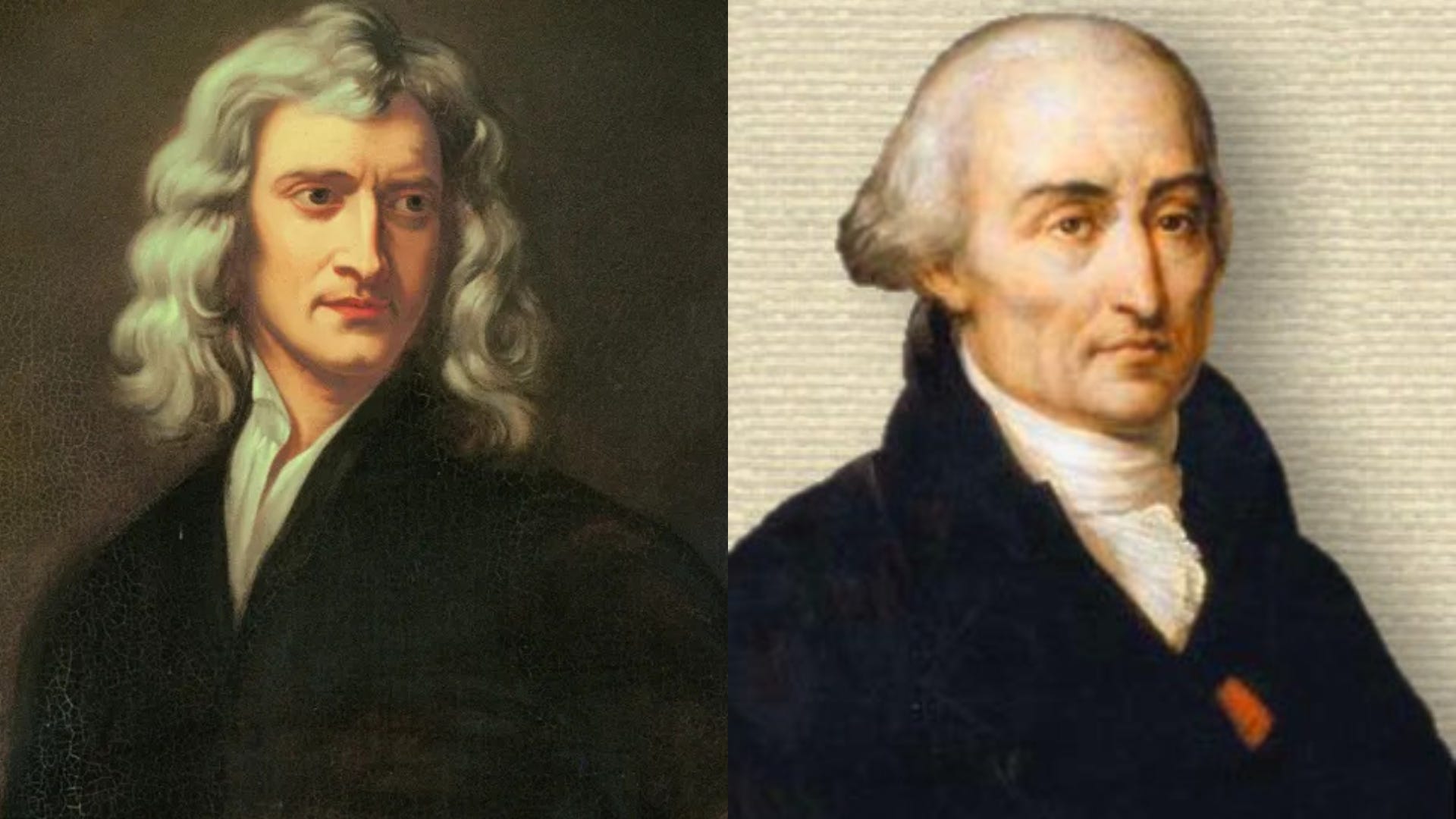
Hamilton describes Lagrange’s work as a “scientific poem” because of its “beauty” and “harmony”.
Lagrange’s formulation, though beautiful, was still complex. To solve the motion of the solar system (the Sun and ten known planets at his time), the methods of the day required integrating thirty ordinary differential equations of the second order, or sixty equations of the first order.
Hamilton’s goal was more ambitious. He wanted to reduce the entire study of motion to the “unfolding of one central relation” by finding a single “characteristic function”.