

Physicists have created nuclear clocks for first time ever.
Researchers at TU Wien and Tsinghua University have shifted timekeeping from electron clouds to the atomic nucleus and it changes everything.

Welcome to Bohring. Here, we look at the universe, life, and science education through a physicist’s lens. If you’re new here, consider joining our community of curious minds:
Imagine a world where :
The Global Positioning System (GPS) in your phone is accurate down to a fraction of a millimeter (mm),
Autonomous vehicles navigate hyper-dense city grids with zero margin for error,
Deep-space probes chart courses through the cosmos without needing to ping Earth for positioning data.
We can peer into the silent fabric of space-time itself to detect dark matter
We can discover if the fundamental constants of nature, like the speed of light, are slowly changing over time.
We can’t build that future with our current best technology. Right now, our modern world runs on atomic clocks.
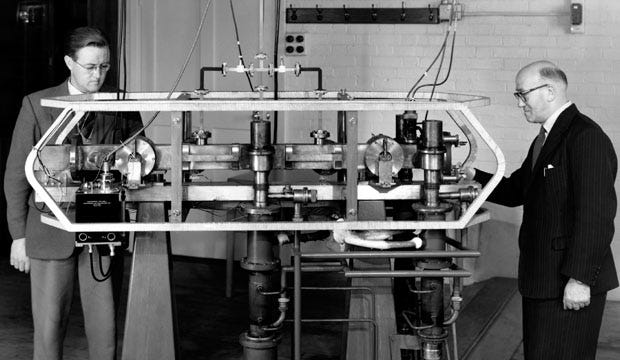
These devices define the precise length of a second by measuring the frequency of light absorbed or emitted when electrons jump between energy levels (the designated orbits where electrons reside) surrounding an atom’s nucleus.
The SI unit of time is the ‘second’. Its current official definition is:
The second (s) is defined by taking the fixed numerical value of the caesium frequency, Δ𝜈Cs, the unperturbed ground-state hyperfine transition frequency of the caesium 133 atom, to be 9,192,631,770 when expressed in the unit Hz, which is equal to s-1.
These optical atomic clocks are marvels of engineering. They lose only a single second over billions of years.
But since electrons live on the outer fringes of the atom, they are exposed. They are inherently sensitive to external environmental noise, such as stray magnetic fields, electric fluctuations, and temperature changes. This sensitivity limits how stable and compact these clocks can become for real-world deployments.
But in a historical scientific double-feature, two independent research groups have bypassed the fragile electron cloud entirely. Published as simultaneous breakthroughs, a European collaboration led by TU Wien in Austria and a Chinese team led by Tsinghua University have successfully built and operated the world’s first working nuclear clocks.
By anchoring timekeeping to the protons and neutrons tightly packed deep within the atomic nucleus rather than the exterior electrons, they have unlocked a system that is naturally shielded against external disturbances by orders of magnitude.
In this article, I break down this discovery for you. Let’s go.
From electrons to the nucleus
To understand this achievement, let’s begin by looking at what makes a clock work. Every clock needs two things:
An oscillating system: something that oscillates at a highly predictable, unchanging rate (a kind of pendulum). In an optical clock, the pendulum is a laser beam whose frequency matches a specific quantum leap.
A counter: to keep track of those oscillations.
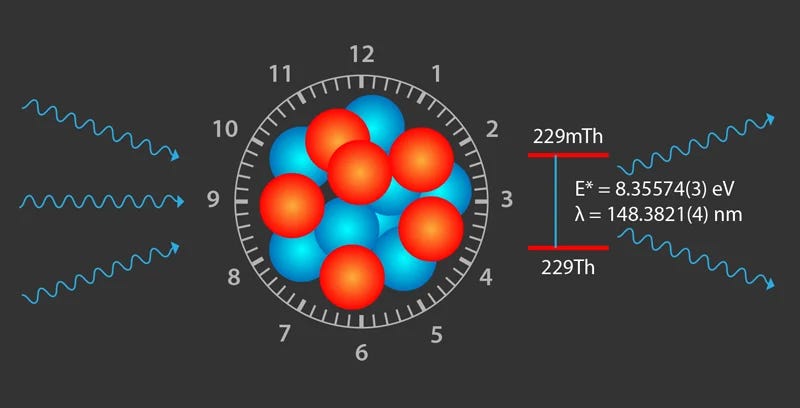
For decades, physicists dreamed of utilizing a nuclear transition as this pendulum. A nuclear transition occurs when the particles inside the nucleus (nucleons: protons and neutrons) absorb energy and move into a temporary, higher-energy arrangement called an isomeric state.
The problem? Most nuclear transitions require millions of times more energy than an electron jump, energies so high (like X-rays or Gamma rays) that they would instantly destroy the equipment or bypass our ability to create stable, continuous laser fields.
Except for one bizarre anomaly in the entire periodic table: Thorium-229 (229Th).
Due to a near-perfect cancellation between the strong nuclear force holding the nucleus together and the electrostatic repulsion pushing it apart, the nucleus of Thorium-229 possesses an incredibly low-energy transition at roughly 8.4 electron-volts (eV). This corresponds to light with a wavelength of approximately 148 nanometers (nm), placing it squarely within the Vacuum-Ultraviolet (VUV) spectrum. VUV light is a band of ultraviolet radiation that is completely absorbed by air, meaning these systems must operate inside a vacuum. This wavelength is perfectly accessible by modern lasers, making Thorium-229 the golden key to nuclear timekeeping.
Who did it?
The race to turn this theoretical concept into a physical clock came to a head in June 2026, driven by two separate international powerhouses:
European Team (TU Wien) was led by Luca Toscani De Col and Thorsten Schumm, working alongside metrologists from the Austrian Federal Office of Metrology (BEV) and Germany’s PTB.
Chinese Team (Tsinghua University) was led by Beichen Huang, Shiqian Ding, and an expansive domestic coalition including the National Institute of Metrology (NIM) in Beijing.
While both groups achieved the same monumental milestone, they engineered very different solutions to generate the necessary VUV laser light and read the nuclear response.


💻 A note for my free community:
Below, we transition from the core concept of nuclear timekeeping to the exact engineering feats that made it possible. In the rest of this premium deep dive for paid community members, I discuss:
A detailed breakdown of both TU Wien’s and Tsinghua University’s laser setups.
The technology that keeps a laser locked onto the Thorium-229 nucleus.
Analysis of Allan deviation plots and shot-noise limits.
What nuclear quantum sensors mean for testing fundamental constants and detecting dark matter.
To unlock the rest of this deep dive and support Bohring, consider upgrading to a paid membership!