

What Are Quantum Fluctuations?
Zero-point energy, virtual particles, and the world's most expensive "bookkeeping" error.


Article #5 in Quantum Field Theory series.When two particles collide and new particles appear, they do not conjure matter from nowhere. The resources for those excitations come from the quantum fields themselves: from the vacuum and its allowed modes. In QFT, the vacuum is not an inert backdrop but an active participant in every interaction.
In a deep sense, the vacuum has potential.

Why the Vacuum Cannot Be Quiet
Quantum systems cannot have perfectly precise, unchanging values for certain pairs of properties known as canonically conjugate variables. Even in their lowest-energy state, they retain an irreducible, unavoidable jitter.
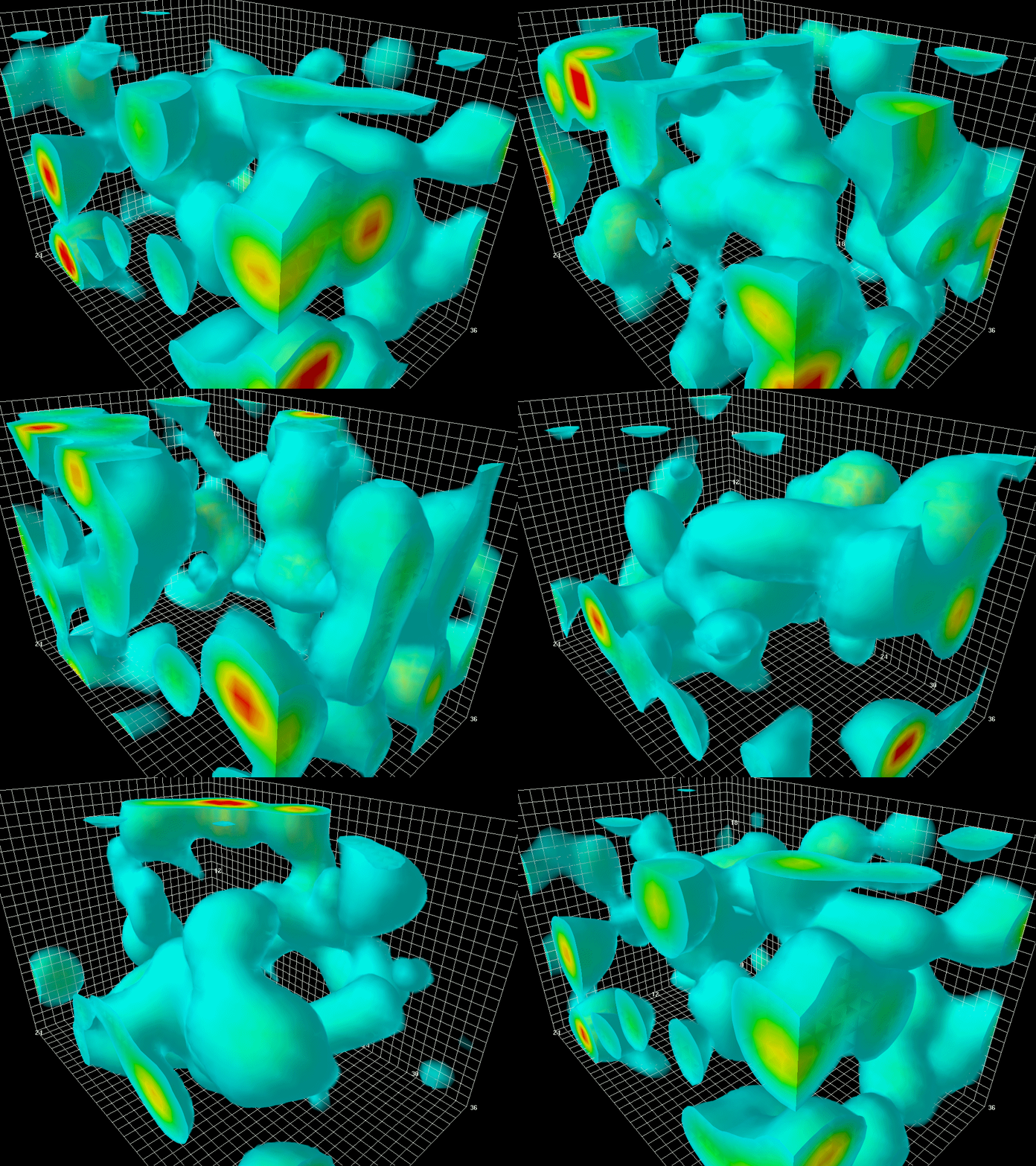
Because of this, every quantum oscillator associated with a field hums with a baseline of restless motion even at zero temperature. This is known as zero-point motion. When an enormous number of such oscillators are summed across space, the result is a vacuum that is far from calm. At microscopic scales, it is surprisingly violent.
These vacuum fluctuations are not just mathematical curiosities. They are responsible for real physical effects (such as the Casimir force and the Lamb shift), and they play a central conceptual role in QFT.
Virtual Particles: Not Quite Real, Not Quite Imaginary
The restless activity of the vacuum is described mathematically in terms of virtual processes. These are disturbances of quantum fields that contribute to interaction probabilities but do not obey the same “on-shell” energy–momentum relations as long-lived particles.
Virtual particles are best understood as bookkeeping devices. When two charged particles influence one another, it is not that they are continuously throwing real particles back and forth. Instead, their fields interact, exchange energy and momentum, and perturb one another. In perturbation theory, this exchange is represented mathematically as the exchange of a virtual particle.
The vacuum, with its sea of fluctuations, provides the canvas on which these exchanges are calculated. Crucially, although virtual particles themselves are not directly observable, the processes they encode leave observable fingerprints.
Experiments That Feel the Vacuum
If the vacuum were only a mathematical nicety, it would be easy to dismiss. Physics, however, is conservative about what it calls “real.” The vacuum earns its status because its effects are experimentally measurable.
The Lamb shift.
In hydrogen atoms, the electron’s energy levels are shifted slightly from what a purely classical Coulomb picture predicts. This tiny discrepancy, first measured in the 1940s, is explained by the interaction of the electron with vacuum fluctuations. It was one of the first clear signs that the quantum vacuum has physical consequences.
Spontaneous emission.
An excited atom placed in empty space will eventually fall to a lower energy state by emitting a photon. Classically, if there were truly nothing around, how would the atom decide to emit? Quantum theory shows that vacuum fluctuations act as a stimulating background that seeds emission. This shows that the vacuum is an active environment that influences matter.
The Casimir effect.
Two uncharged, parallel metal plates placed extremely close together in a vacuum experience a measurable attractive force. The plates alter the allowed modes of quantum fields between them compared to outside, producing a pressure difference that nudges them together. This is a direct mechanical force arising from the structure of the vacuum itself.
Van der Waals forces.
The weak attraction between neutral molecules has a close kinship with vacuum fluctuations and the way quantum fields polarize matter across empty space.
Together, these effects demonstrate that the vacuum is something experiments can feel.
Polarization and Screening
The vacuum behaves like a medium that can be polarized. A charged particle does not sit alone in empty space; it is surrounded by a cloud of virtual particle–antiparticle pairs that slightly screen its charge.
In quantum electrodynamics, this leads to vacuum polarization. The effective charge seen by a distant test particle differs from the “bare” charge at very short distances. The vacuum rearranges itself around real particles, altering how forces behave across length scales.
This is not poetic language. It has direct, testable consequences in scattering experiments and precision atomic measurements.
Zero-Point Energy and a Cosmological Puzzle
Because every oscillator in every quantum field carries zero-point energy, summing them all produces an enormous predicted energy density for empty space. Naively, quantum field theory predicts a vacuum energy vastly larger than what cosmology observes.
Observations of the universe’s expansion reveal a tiny but nonzero cosmological constant, an energy density of empty space that is astonishingly small compared to naive QFT estimates. The mismatch, spanning many orders of magnitude, is one of the deepest unsolved problems in theoretical physics.
I previously talked about this vacuum energy problem in this article:

Physicists have proposed many possible resolutions: unknown cancellation mechanisms, revisions of our understanding of gravity, or even anthropic reasoning in a multiverse context. Whatever the answer, the cosmological constant problem is a stark reminder that the quantum vacuum is not a side detail but a central to our understanding of spacetime itself.
When Observers Matter: Unruh and Hawking
The vacuum is not absolute in a trivial sense. What one observer calls “empty,” another may not.
An accelerating observer in otherwise empty space perceives a bath of particles with a temperature proportional to their acceleration. This is the Unruh effect. Near a black hole, spacetime curvature and the presence of an event horizon allow quantum effects that an outside observer perceives as thermal radiation known as the Hawking radiation.
Note: We'll talk about these effects in detail at the end of the series.Both phenomena reveal a strange but profound truth that once quantum mechanics and relativity are combined, notions of particles and emptiness become observer-dependent.
Hawking radiation, in particular, ties the vacuum to gravity in a deep way. Pair production near the event horizon can result in one particle escaping as radiation while the other falls inward; a heuristic picture of how black holes can evaporate over cosmological timescales. Once again, the restless vacuum becomes the engine behind macroscopic, even cosmic, phenomena.
Symmetry Breaking and the Vacuum’s Structure
Not all vacua are equally featureless. In many field theories, the lowest-energy configuration breaks symmetries that the underlying laws possess.
A helpful analogy is a round table with many identical seats. The table is symmetric, but once a system chooses a particular seat, that symmetry is broken. In field theory, such spontaneous symmetry breaking can reorganize interactions and endow excitations with mass.
The Higgs mechanism is the most famous example. The vacuum expectation value of the Higgs field defines the stage on which particles acquire mass. In this sense, the vacuum acts as a medium whose properties help determine the laws of physics themselves.
Note: Once again, this deserves its own detailed article.Practical and Philosophical Echoes
If you are taking a QFT course, you will spend considerable time accounting for virtual processes in many quantum phenomena.Vacuum effects matter in practice. Precision atomic clocks, particle accelerators, and searches for new physics all rely on careful accounting of subtle vacuum phenomena.
Philosophically, the quantum vacuum reshapes our idea of “nothing.” Nothingness is not a blank slate. It is dynamic, structured, and governed by physical law. The fact that “nothing” can influence the evolution of systems is one of the most unsettling and powerful insights of modern physics.
Next time…
We’ll dive into Spacetime Symmetries to discover how the geometry of the universe itself dictates exactly which fields can exist and why symmetry is the ultimate architect of physical law.


I've read many times that the picture of one virtual particle falling into a black hole and one escaping is misleading. Can you explain?