



This is the second article in the QFT series.The term ‘field’ was introduced to us back in high school physics: electric field, magnetic field, gravitational field. We were told that these are mere invisible influences, extending across the entire space. Yet its true meaning is far stranger and deeper than what intuition suggests. In QFT, fields are not just invisible influences. They are the stuff of reality itself.

Let’s appreciate this radical idea in detail.
From Waves on a String to Fields in Space
We start with something simple: a vibrating string. When you pluck it, waves travel along its length. Every point on the string oscillates, and together they produce sound. The string’s vibration is not one single motion but a coordinated dance of countless points.

Now imagine extending this idea from a string to all of space. Instead of each point on a string, imagine each point in space having a quantity that can vibrate — a number or a vector that changes with time. That is it. That’s a field:
A field is just a physical quantity defined at every point in space and time.
Temperature across a room is a field. The strength of gravity around Earth is a field. The electric and magnetic fields that make up light are, well, fields.
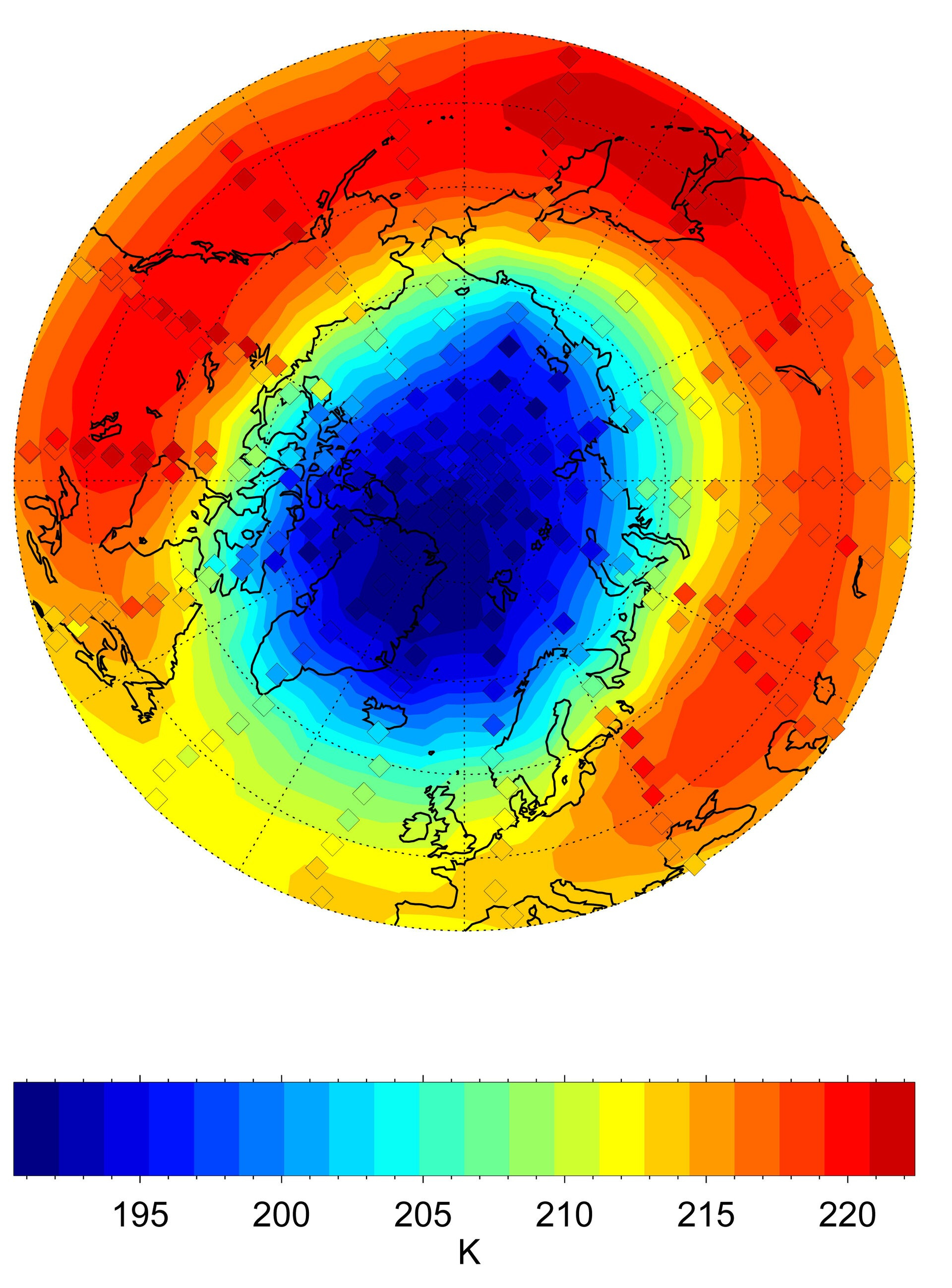
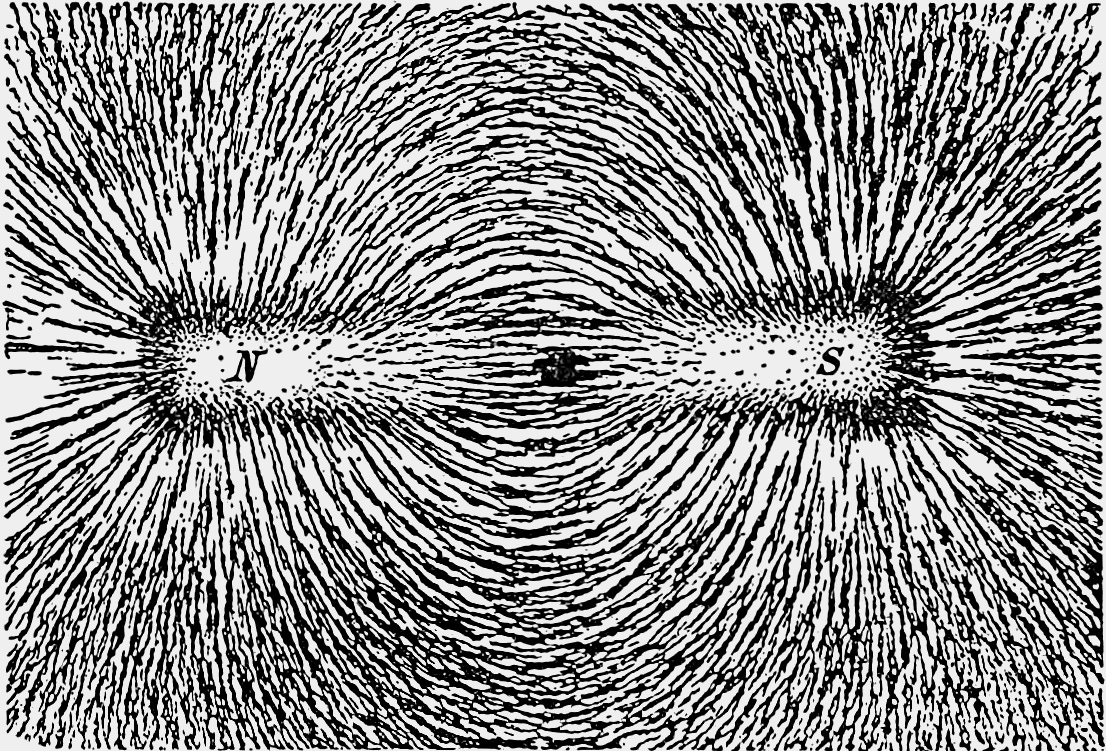
The crucial shift in QFT is that the fields aren’t just mathematical conveniences to describe forces. They exist. They are what’s truly there.
The Leap from Force Fields to Material Fields
In classical physics, fields were introduced to describe forces acting at a distance. Newton couldn’t explain how the Sun’s gravity “reaches” Earth, so later physicists like Faraday and Maxwell reimagined reality as filled with continuous fields. A charged particle didn’t “pull” another one across empty space, but altered the electric field around it, and that field affected others.
That was revolutionary. But even then, fields were considered secondary, as mere tools to describe interactions between particles. QFT reverses that hierarchy.
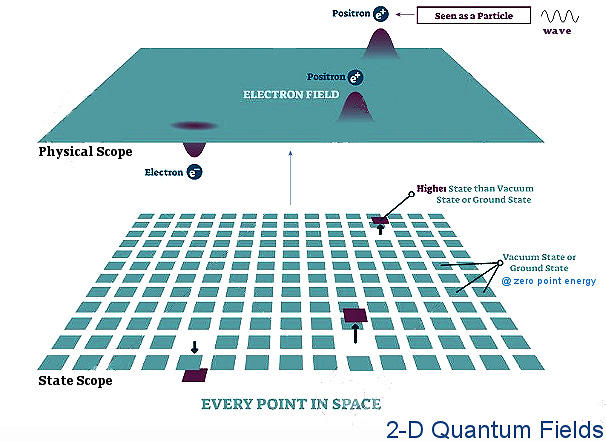
In QFT, there are no fundamental particles that create fields. Instead, there are fields that give rise to particles. An electron is not a tiny bead of matter flying through space. It is a localized vibration in the electron field that fills all of space. The photon is a ripple in the electromagnetic field. The Higgs boson is a ripple in the Higgs field. Everything (every “thing”) is a vibration pattern.
The Stillness Beneath Everything
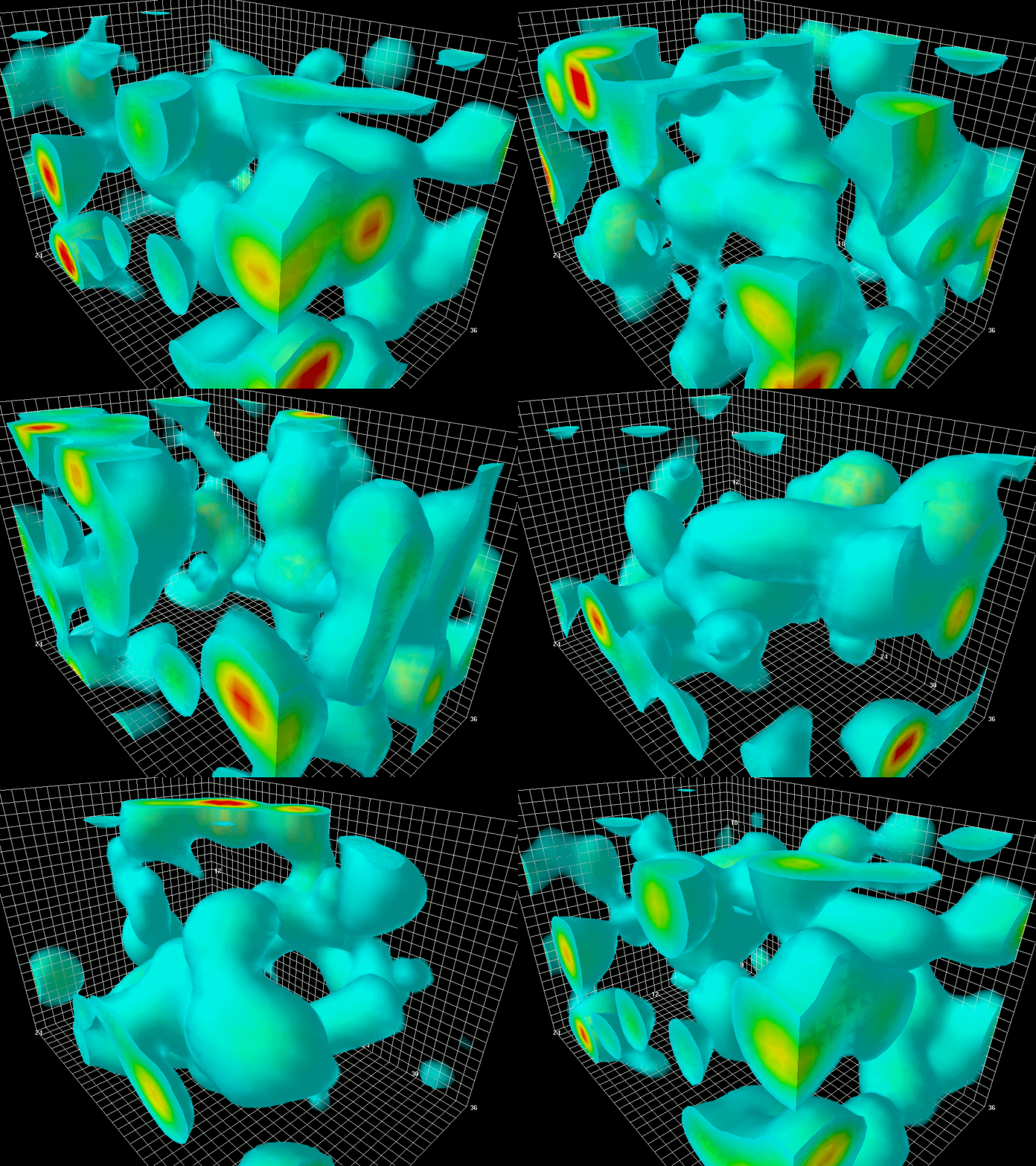
This means that even the emptiest space isn’t truly empty. Even when no particles are present, the fields are still there, resting in their lowest energy state — what we call the vacuum. But “resting” is a deceptive word. Quantum mechanics ensures that these fields can never be completely still. They constantly jitter with microscopic fluctuations — the famous “quantum foam” of the vacuum.
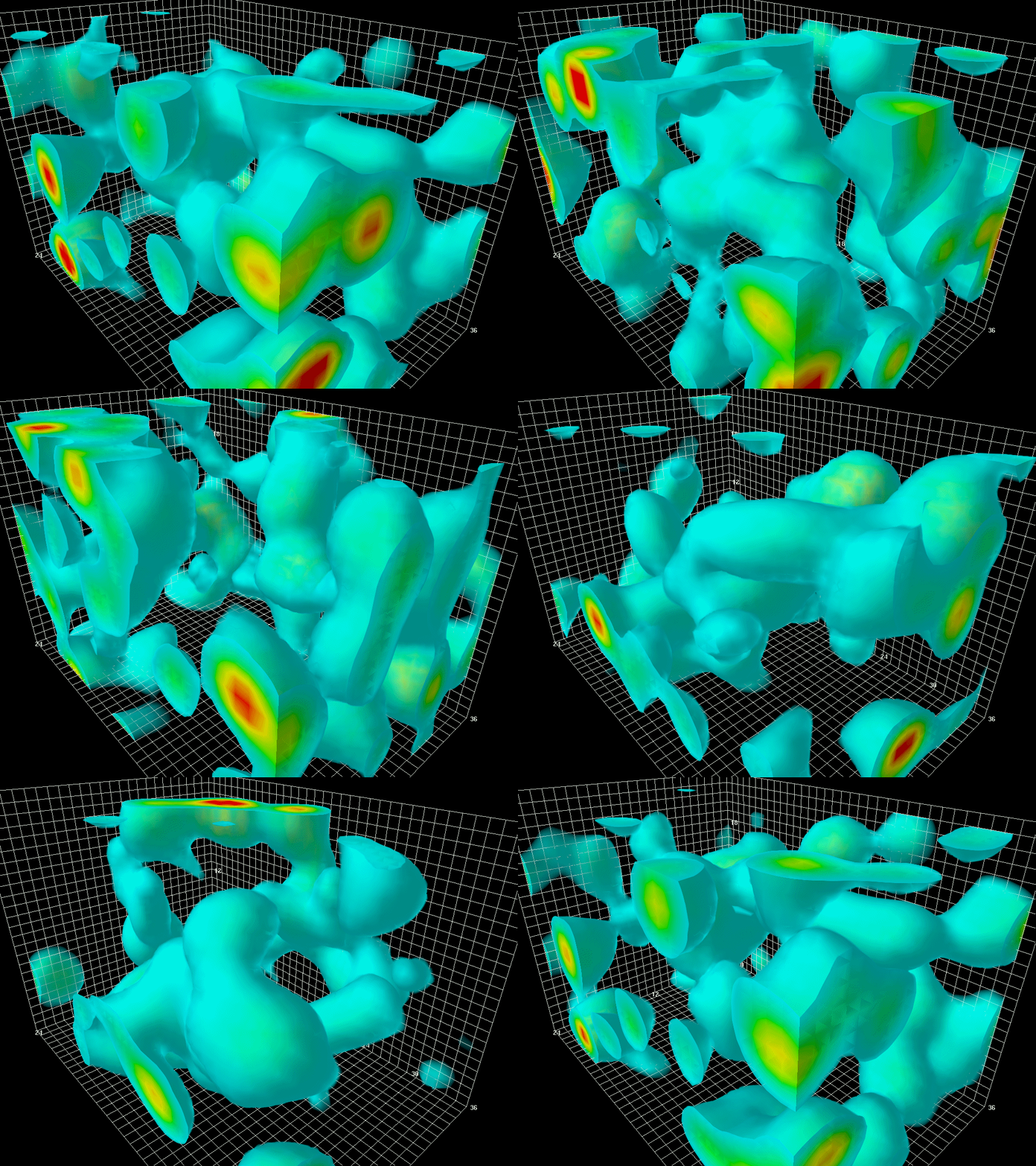
From this restless sea, particles can emerge and vanish, like fleeting ripples on an infinite ocean. When enough energy is supplied, the oscillations are excited, becoming real and measurable. When that energy fades, the ripple settles back into the calm sea of the vacuum.
This is why creation and annihilation are natural in QFT. They are not magical events, but simple rearrangements of energy in the underlying fields.
Why Fields, Not Particles, Make Sense
Consider two electrons approaching each other. In a particle-based picture, we’d imagine them as little balls bouncing off through electric repulsion. But in the field picture, what’s happening is far subtler. Each electron is a disturbance in the electron field, and each carries an electromagnetic field around it. Their interaction is not a direct contact but a conversation between overlapping fields. Energy moves smoothly through these fields, not instantaneously from one point to another.
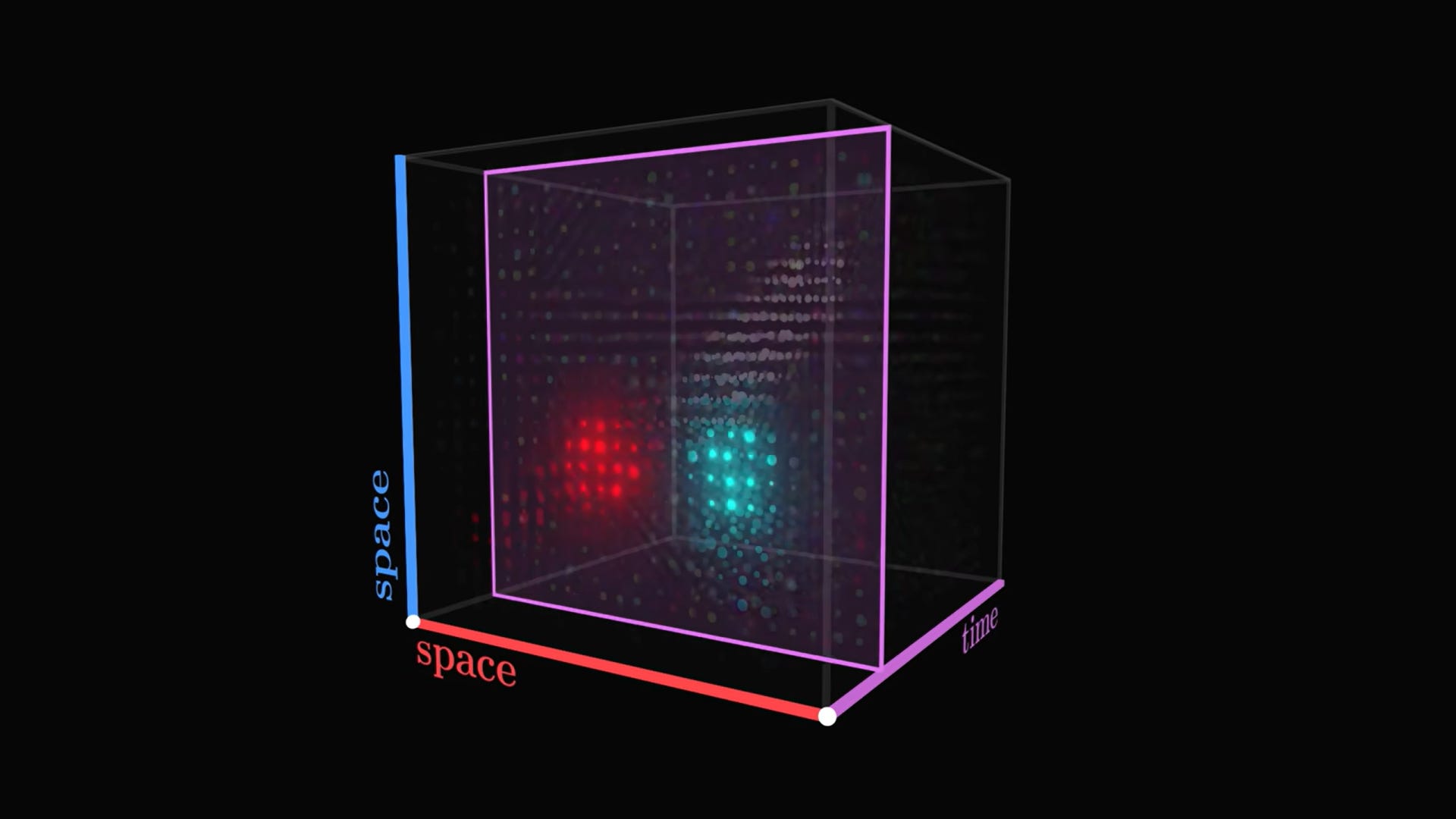
And this idea, extended to all known forces and particles, gives us a unified, continuous picture of reality. The quantum field isn’t made of anything smaller; it is the foundation.
Vibrations as Identity
Different kinds of fields correspond to different types of particles. The electron field can vibrate only in certain ways, giving rise to electrons and positrons. The photon field vibrates differently, producing light. The quark fields create quarks, and the gluon field glues them together. Every type of particle we know is simply a distinct mode of vibration in its own field.
It’s a bit like musical notes: all arising from vibrations, but differing in tone and pattern. A photon is not a different “substance” than an electron; it’s a different melody played by a different instrument.
When you hold out your hand, you’re not holding a cluster of particles, but a set of standing waves: stable, self-sustaining patterns in the universe’s vast field network.
A Universe Made of Motion
The field picture tells us that matter isn’t made of things, but of happenings. The universe is not built from blocks but from events: vibrations, excitations, movements in something continuous and ever-present.
The field picture is a profound departure from how we instinctively imagine the world. We’re used to objects having edges, existing “here” and “there.” But a field is everywhere. You can’t separate one part of the electron field from another; it’s one continuous whole spread across the cosmos. What we call “an electron” is just where that field happens to be excited. So… in a very real sense, all electrons are connected: they’re the same field, vibrating in different places.
Coming up next week…
Now that we’ve built the intuition of what a field really is, it’s time to level up. Next time, we’ll explore the building block of the universe made of quantized fields: the harmonic oscillator.
If you like my work, please subscribe. That +1 keeps me going.




Thanks for the interesting series! The equation-free presentation is helpful. But having read this, I don’t feel like I know what the fields are. Are all the different particles different patterns of vibration in the same field, like violins and trumpets both vibrate air, or are they carried in different media like sound vs light? In either case, do we know how many media there are?