

Why is the Double Pendulum unsolvable? Non-Linearity and Chaos explained
Two simple pendulums attached end-to-end break predictability and expose the limits of classical mechanics.

Welcome to Bohring. Here, we look at the universe, life, and science education through a physicist’s lens. If you’re new here, consider joining our community of curious minds:
The double pendulum is the ultimate bait-and-switch of physics.
A simple pendulum is just a mass tied to one end of a string. It’s the simplest example of the periodic system. Its dynamics are governed by a straightforward differential equation:
where L is the length of the pendulum, θ is its angle of release, t is time, and g is the acceleration due to gravity.
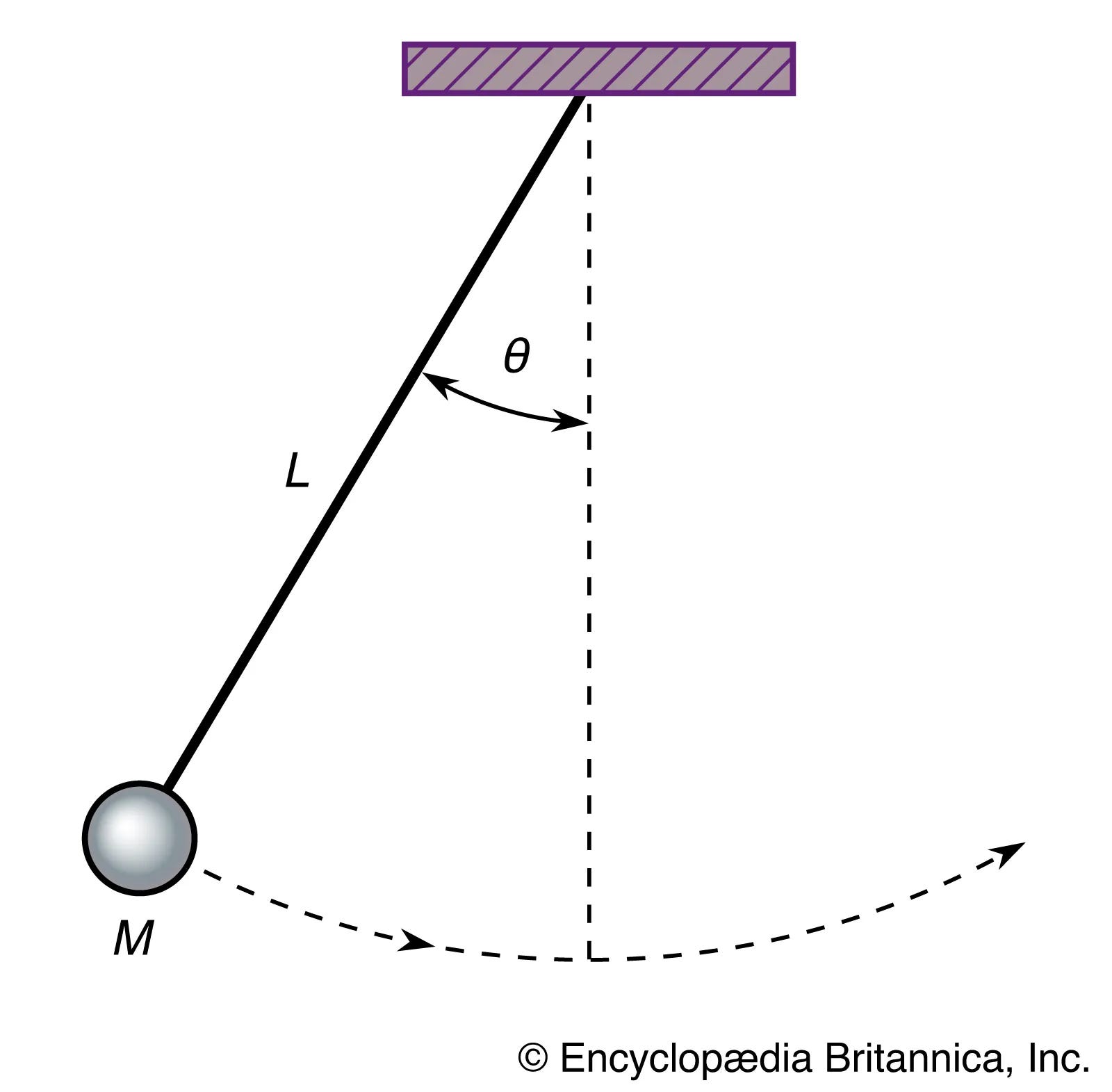
It behaves so well that we have used it to keep time for centuries. More importantly, it is predictable.
A double pendulum is just a second pendulum attached to the bottom of the first. It looks simple enough— just two rods and two weights. Surprisingly, this system is chaotic. Its motion resembles a frantic gymnast in action. It flips and jerks.

Why can’t we write down a neat equation to predict its exact position an hour from now Because the double pendulum is unsolvable.
Determinism is an illusion here
Newton gave us a clockwork universe. In classical mechanics, if you know the initial positions and velocities of a system, and you know the forces acting on it, you can use the laws of motion to predict the future forever.
For a long time, physicists believed that “unsolvable” just meant “we haven’t tried hard enough yet.”
When we write down the equations for a double pendulum, we use something called Lagrangian mechanics, which looks at the energy of the system rather than just the raw force vectors. We get a set of differential equations that describe the acceleration of both weights at any given moment:
The math is deterministic. There is no randomness involved. So, where does it go wrong?
Bohring is entirely reader-supported. The deep-dive physics series and philosophical essays are made possible by the “Deep Divers”—the paid community members who value independent science communication.
If you’re currently on the free tier, consider upgrading to a paid subscription to unlock exclusive deep dives, archives, and chat:
Non-Linearity poses a trap
The problem is that these equations are non-linear.
In a single pendulum, if we keep the swings small, we can use a mathematical trick called the small-angle approximation, where we pretend the sine of an angle, sin(θ), is just equal to the angle itself (θ):
This turns a nasty non-linear equation into a linear one.
Linear equations scale predictably. If you double the input, you get double the output.
For mathematically inclined readers, here is the solution to the single pendulum.
Define angular frequency:
Our equation becomes:
Assume a solution of the form:
Substitute the derivatives into the equation:
Factor out ert since ert ≠ 0, giving the characteristic equation:
This yields the complex general solution:
Using Euler’s Formula (eiα = cosα + isinα), we rewrite this as:
Applying a trigonometric identity transforms this to the phase-shift form:
But in a double pendulum, the small-angle approximation breaks down completely. The motion of the double pendulum is inherently violent and interconnected. The position of the top mass radically alters the gravitational torque on the bottom mass, and the momentum of the bottom mass whips the top mass around.
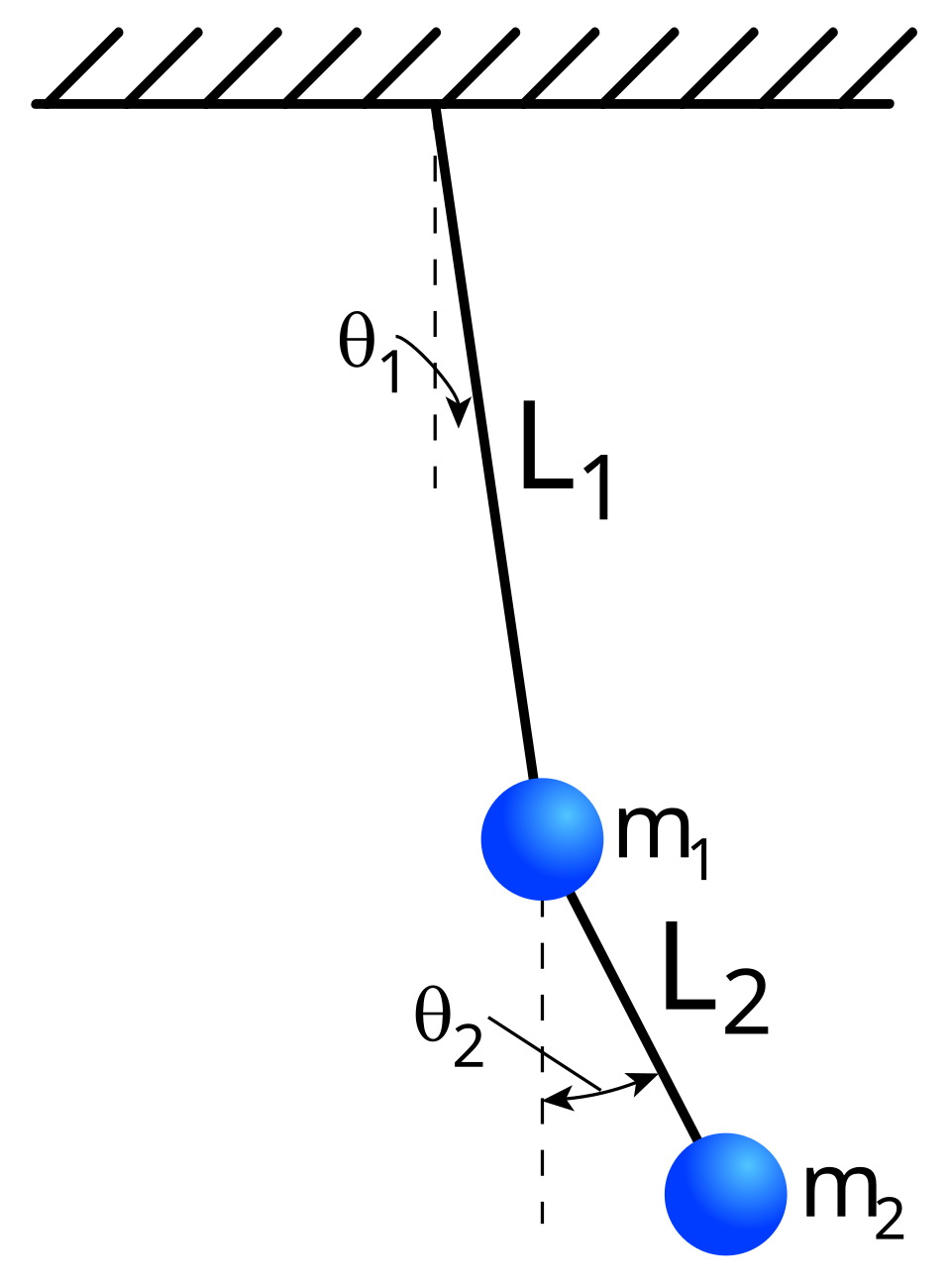
When you write out the equations of motion, you get terms where the movement of each pendulum is tightly coupled to the other through non-linear trigonometric functions of their angle difference, like sin(θ1 - θ2).
You cannot separate them. You cannot linearize them without stripping away the very behavior that makes it a double pendulum.
Because the equations are non-linear, we cannot find an analytical solution. An analytical solution is a neat mathematical expression, a formula where you plug in time (t), and it spits out the exact coordinates. You can’t solve it with a pen and paper using standard calculus. It is mathematically proven that no such closed-form solution exists.
Chaos and the Butterfly Effect
Since we can’t solve it exactly, we hand it over to a computer. Computers solve the unsolvable by using numerical integration. Instead of calculating where the pendulum will be in an hour, the computer calculates where it will be in the next 0.0001 seconds, updates the position, and repeats the process.
This works brilliantly for sending rockets to Mars. It fails with the double pendulum because of deterministic chaos. The double pendulum is hyper-sensitive to initial conditions—a phenomenon popularly known as the Butterfly Effect. Suppose you hold the pendulum up and release it. Now, suppose you do it a second time, but your hand shakes by a microscopic fraction of a millimeter.

For the first few seconds, the two runs will look identical. But because the system is non-linear, that microscopic difference doesn’t stay microscopic. It compounds exponentially. Within twenty seconds, the first pendulum might be looping over the top while the second one is swinging lazily to the left.
Because we can never measure the starting position of a physical object with absolute, infinite precision, perfect long-term prediction is impossible. Even on a supercomputer, tiny rounding errors in the sixteenth decimal place will eventually balloon until the computer’s simulation bears no resemblance to reality.
Beauty of the unsolvable
Notice the irony here. The double pendulum is governed by completely known, deterministic laws. It is a classical system. It has no free will. It has no external noise. Yet, it generates behavior so complex that it might as well be completely random.
The double pendulum is the ultimate bait-and-switch of physics. It serves as a boundary between knowing the laws of nature and predicting the outcomes of nature. The universe isn’t a simple clockwork machine. Two pieces of string and two brass weights are all it takes to prove it.
Thank you for reading. If my reflections on life or physics resonated with you today and you’d like to support my independent writing without committing to a monthly subscription, you can drop a small tip in my digital jar. It keeps me motivated.
Enjoyed this piece? Writing these essays takes me hours of research and distillation. If it sparked a new thought or made a complex concept click, please consider sharing it with a friend or colleague who loves a deep dive.
What are your thoughts on chaos and determinism? Let’s chat in the comments below.
You Can Also Read:


I believe you missed several plus signs in the single case math