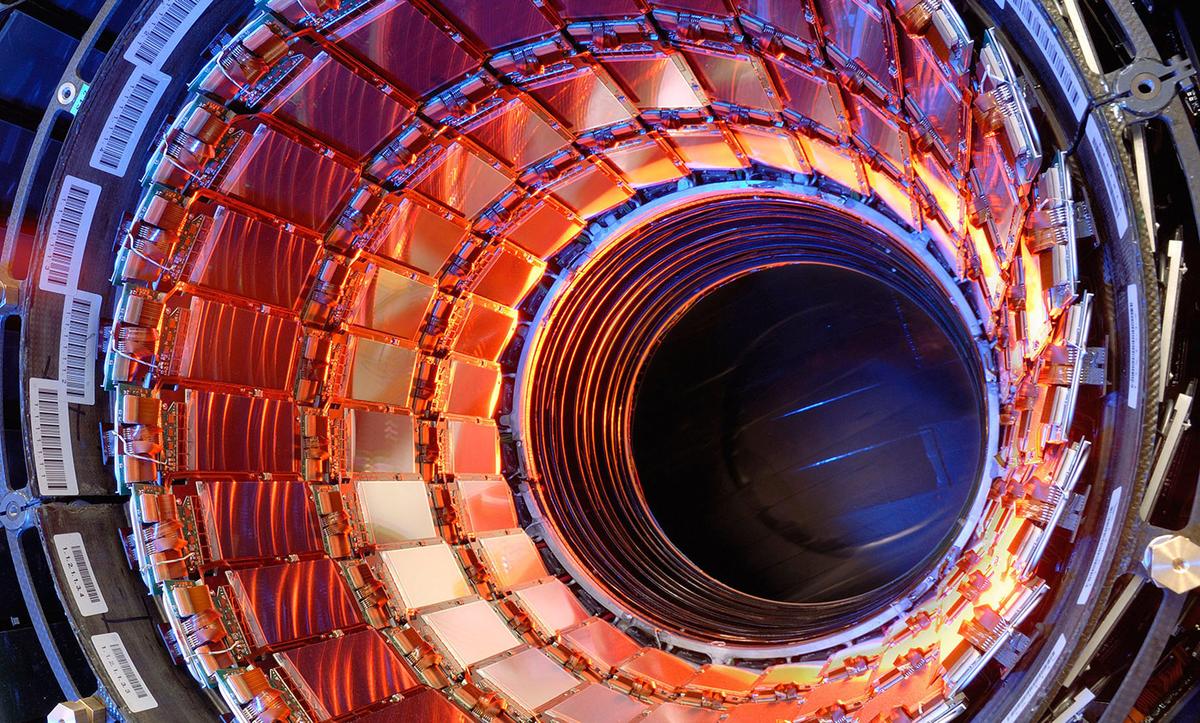
Explained: How Particle Colliders Work?
An intuitive guide to cross-sections, S-matrices, and the real science of the LHC.

We are a community of 1000 physics enthusiasts!
Fun Fact: If you read our articles regularly, you understand universe better than 99% of world’s population. You’re welcome!
Article #10 in the Quantum Field Theory series.I know I was supposed to discuss Renormalization. But I realized there is something more important we should discuss at this point. For months now, we’ve been building the “theory” of quantum fields. Before we go any deeper, I want to ground us in the experimental side of the field so we can see how these ideas actually manifest in the real world.
So today, I will talk about particle colliders. Yes, those magnificent machines like the Large Hadron Collider (LHC) at CERN. I want to begin by discarding the image that almost everyone (including many physics students) carries in their head:
A collider is not a machine that smashes tiny solid particles together like billiard balls.
If that were true, quantum field theory (QFT) would be grotesquely over-engineered. We wouldn’t need fields, creation operators, virtual particles, or Feynman diagrams. Classical mechanics plus a bit of quantum seasoning would do. And yet, every successful prediction of high-energy physics, from antimatter to the Higgs, comes not from particle mechanics, but from quantized fields.
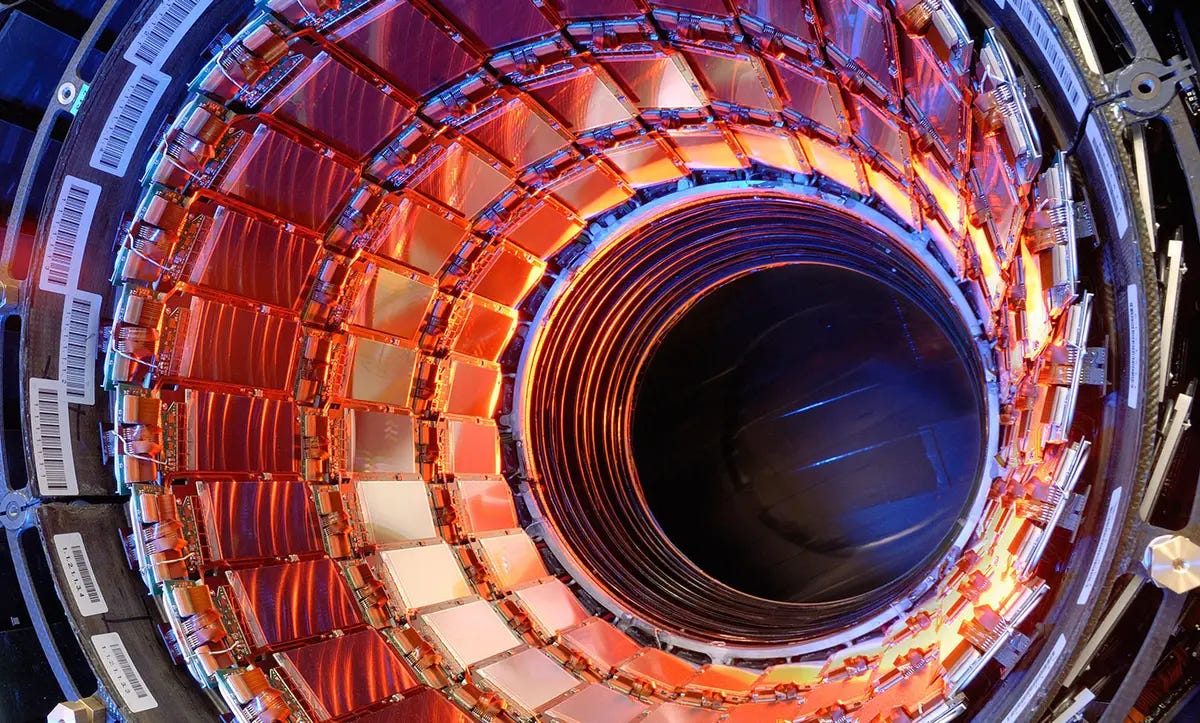
What a Collider Is Really Doing
At its most honest description, a collider does three things:
It prepares specific quantum field excitations with certain energies, momenta, charges, and spins.
It allows those excitations to interact briefly
It measures how the field reorganizes afterward
That’s it.
Before the collision, you have localized wave packets moving toward each other at relativistic speeds. After the collision, you again have wave packets, possibly of different types, different masses, and different numbers.
And in between? In between is a short spacetime region where fields interact with each other, which I discussed here:

Cross Sections
A cross-section in QFT is essentially a measure of how likely a particular interaction is to occur when two field excitations encounter each other.
Imagine you’re skipping stones across a perfectly still pond. You’re trying to hit a specific spot, maybe a floating leaf. The bigger the leaf, the easier it is to hit. This is the classical intuition for cross-section. But when wave packets interact inside a collider, how much they do and in what way is not about physical size but probabilities. It’s about the effective area an object presents to an incoming projectile, which may depend on a variety of variables, such as the energy of the particles, and is generally larger than the physical surface area.
Let’s say we accelerate two proton beams (which are complex composite ripples of quarks and gluons) to very high energies and send them towards each other. Most of the time, they just sail past each other. That’s a “miss.” But sometimes, a gluon from one proton might interact with a quark from another. Or two gluons might slam into each other. When they do, the fields involved experience a powerful kick. The probability of this “kick” happening, and leading to a specific outcome (say, creating a new, heavier particle), is what the cross section quantifies.
Decay Rates
When we kick our fields really hard, we sometimes manage to excite a new, much heavier ripple – a new particle. But many of these heavy ripples don’t stick around for long. They decay into lighter particles almost instantaneously. This phenomenon is quantified by the decay rate.
Heavy particles are essentially very high-energy, unstable excitations of their respective fields. Nature, as we’ve discussed before, on the other hand, generally prefers lower energy states. A massive particle represents a significant concentration of energy. If there’s a “pathway” for that energy to be released into lighter, more stable configurations of other fields it can interact with, it will take it.
Every particle has a natural linewidth or lifetime. For some, their decay rate is practically zero. They are exceptionally stable, low-energy ripples that just keep going. For example, the proton’s lifetime is many orders of magnitude higher than the age of the universe. On the other hand, the lifetimes of many of the particles created in colliders are incredibly short. For example, the Higgs Boson exists for only 10-22 seconds before it decays into lighter particles.
Transition Amplitude
What happens between the initial state and the final observed particles?
During this interaction period, space is a chaotic, buzzing soup of fluctuating quantum fields where energy momentarily condenses into heavy, unstable particles. This is the ‘black box’ of QFT, captured by a concept called the transition amplitude, often bundled into what physicists affectionately call the S-matrix (for ‘scattering matrix’).
The S-matrix describes the probability of transitioning from a specific initial state (such as two high-energy protons) to a specific final state (like a shower of electrons and muons). We feed it the ‘in-states,’ and it provides the probabilities for all possible ‘out-states,’ governed by the coupling strengths between the various fields.
This concept underpins everything we do at colliders. In practice, the job of a particle physicist is to piece together those final states and work backward to infer what happened in that fleeting moment of intense interaction.
Resonance
Imagine you’re pushing a child on a swing. If you push at just any random time, the swing might not go very high. But if you push at precisely the right moment, in sync with the swing’s natural rhythm, you can get it to go incredibly high with minimal effort. That’s resonance.
Resonance is a powerful phenomenon that helps us discover new particles and understand their fundamental properties.
Each fundamental field has its own natural “vibration modes” or preferred frequencies at which it likes to oscillate. When we pump energy into a quantum field during a collision, we’re essentially trying to excite it. If the energy we supply matches one of these natural modes, the field absorbs that energy very efficiently, creating a particularly prominent, temporary excitation. This excitation is what we call a particle.
So, when physicists collide particles and look for new ones, they’re essentially looking for energy sweet spots. They’re systematically increasing the collision energy, much like tuning a radio dial, trying to find a frequency where the universe suddenly “lights up” and produces an abundance of specific decay products.
Phase Space
What does a heavy, unstable particle decay into? What are the rules governing these transformations? This is where phase space comes in.
Phase space quantifies the number of available ways for a set of particles to decay into a specific final state while obeying fundamental rules of the universe.
The rules governing these transformations are the conservation laws. When a particle decays, it doesn’t just arbitrarily spit out whatever it feels like. It must shed its energy and transform into other particles whose combined properties (mass, energy, momentum, charge, spin) add up correctly, satisfying all the conservation laws.
It’s not about what will happen, but what can happen, given the initial conditions. A larger phase space for a particular decay channel means there is more “room” or “options” for that decay to occur, and therefore it generally has a higher probability (a larger decay rate, as we discussed).
Detectors
Now you might ask, “How can we observe these ephemeral field interactions that last for only 10-23 sec?”
This is where the magnificent and mind-bogglingly complex particle detectors come in. Truth is, we can’t see these short-lived particles directly. We only detect the footprints they leave behind as they interact with matter in our detectors.
A particle detector, like the ATLAS or CMS detectors at the LHC, is a colossal, multi-layered onion of sophisticated instrumentation, each layer designed to measure a specific property of the outgoing particles.
For instance:
Tracking Detectors (Inner Layers) help us determine the particle’s momentum.
Calorimeters (Middle Layers) measure a particle’s energy.
Muon Chambers (Outer Layers) track these muons, which pass throught the inner layers undetected.
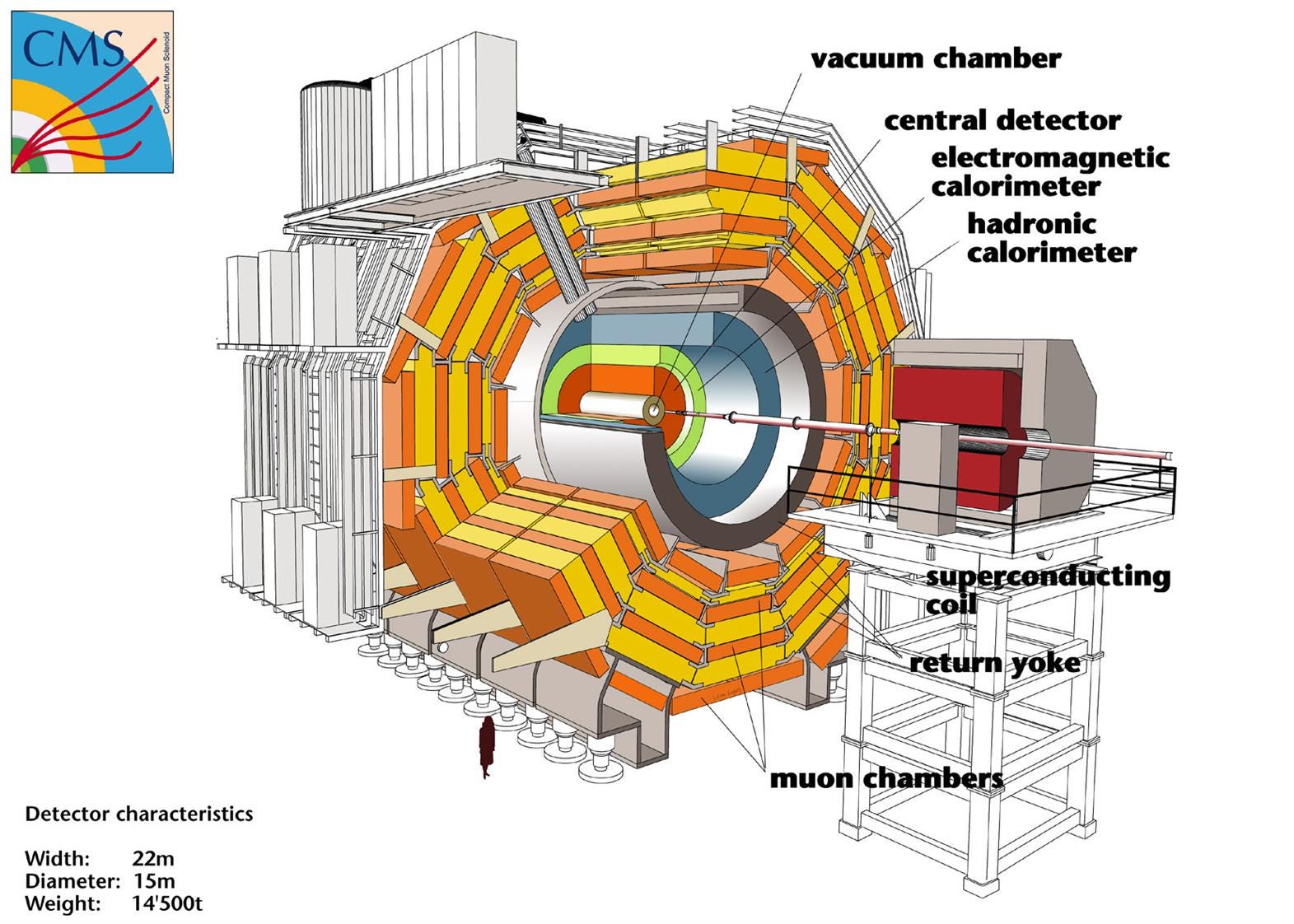
How each of these layers works is itself a very interesting topic of discussion, but I reserve it for some other day.
So, when a proton-proton collision happens, we get a spray of these secondary particles, which are registered as “hits” in the detector. Each hit is an electrical signal. Computers then piece together these signals, reconstructing the individual particle tracks, energies, and identities.
I’d like to end with this analogy:
If QFT is the script for the universe’s grand play, then a particle collider is the ultimate experimental theater. It’s where the experimentalists get to witness the dramatic interactions of fields, to see if the script written by theorists truly matches the improvisation of nature.
Coming Sunday…
We will either discuss more about colliders or delve into Renormalization. I haven’t made my decision yet! But…
Isn’t it amazing I can explain such complex topics with visual analogies?! Help me keep this flame of science communication burning. Will you...
Your support is all I’ve got. Don’t forget to…