Okay, but How Quantum Fields Create Forces?
A Guide to Gauge Symmetry and How Particles Talk?

Article #8 in the Quantum Field Theory series.Up until now, we’ve looked at quantum fields in isolation. But a universe where fields don’t talk is a dead universe. For stars to shine, for atoms to hold together, and for you to read these words, these fields must interact.
In classical physics, we “added” forces by hand. We’d say, “Here is a particle, and by the way, it feels a force.” But in QFT, we want the universe to be logically inevitable. We don’t want to add forces; we want them to emerge.
Let’s see how QFT makes this possible.
Gauge Field, Revisited
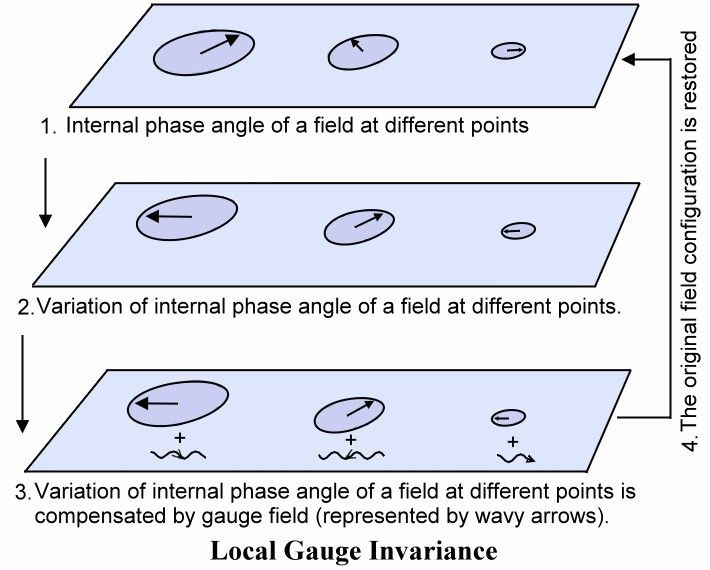
In the sixth article of the series, we saw that local symmetry, which is the freedom we demand to rotate our metaphorical “internal clocks” differently at every point, requires a compensating field. But how does this translate into a physical force?
In QFT, the tension of a field is determined by how it changes from one point to the next. If you rotate your clock in London but not in New York, you create a mathematical twist. Without a mediator, the field breaks. The Gauge Field is that mediator. In physics, we call it a connection. It acts as a bridge, absorbing your local changes so the electron field doesn’t feel any artificial tension.
So the photon doesn’t just exist to be light; it exists to perform the trillion-times-a-second accounting required to keep the electron’s local symmetry from collapsing. Each fundamental force is simply a different kind of accounting system for a different kind of internal freedom.
From Action at a Distance to Local Conversations
To understand how these symmetries actually manifest as “pushing and pulling,” we must exorcise a ghost called Action at a Distance.
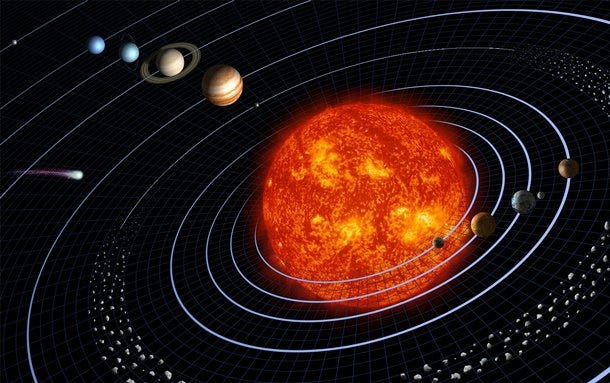
Newton’s gravity suggested that if the Sun vanished, Earth would react instantly. QFT provides a better explanation. Fields don’t know what’s happening far away. They only know what is happening in their immediate neighborhood. For an electron to affect another, it must disturb the field around it. That disturbance ripples outward like a wave. So…
Interaction is not a telepathic connection; it is a local conversation.
Force as a Messenger Exchange
In QFT, we replace the “invisible hand” of force with a “postman.” Imagine two ice skaters on a frozen lake. If Skater A throws a heavy medicine ball to Skater B, Skater A recoils. When Skater B catches it, they are pushed back. To a distant observer, it looks like a repulsive force, even though the skaters never touched.

Similarly, if A throws a boomerang behind B, B will be pushed towards A. This is the force of attraction.

In QFT, the medicine ball and boomerang are gauge bosons: a photon, a gluon, or a W/Z boson. A force is simply what happens when two matter fields trade energy and momentum via a force field.
The Feynman Picture: Math as Narrative
In the quantum world, if something can happen, it does happen. To find the true probability of an interaction, physicists must sum up every possible way the fields could have talked: from a simple “hello” to a complex, convoluted gossip chain of virtual particles.
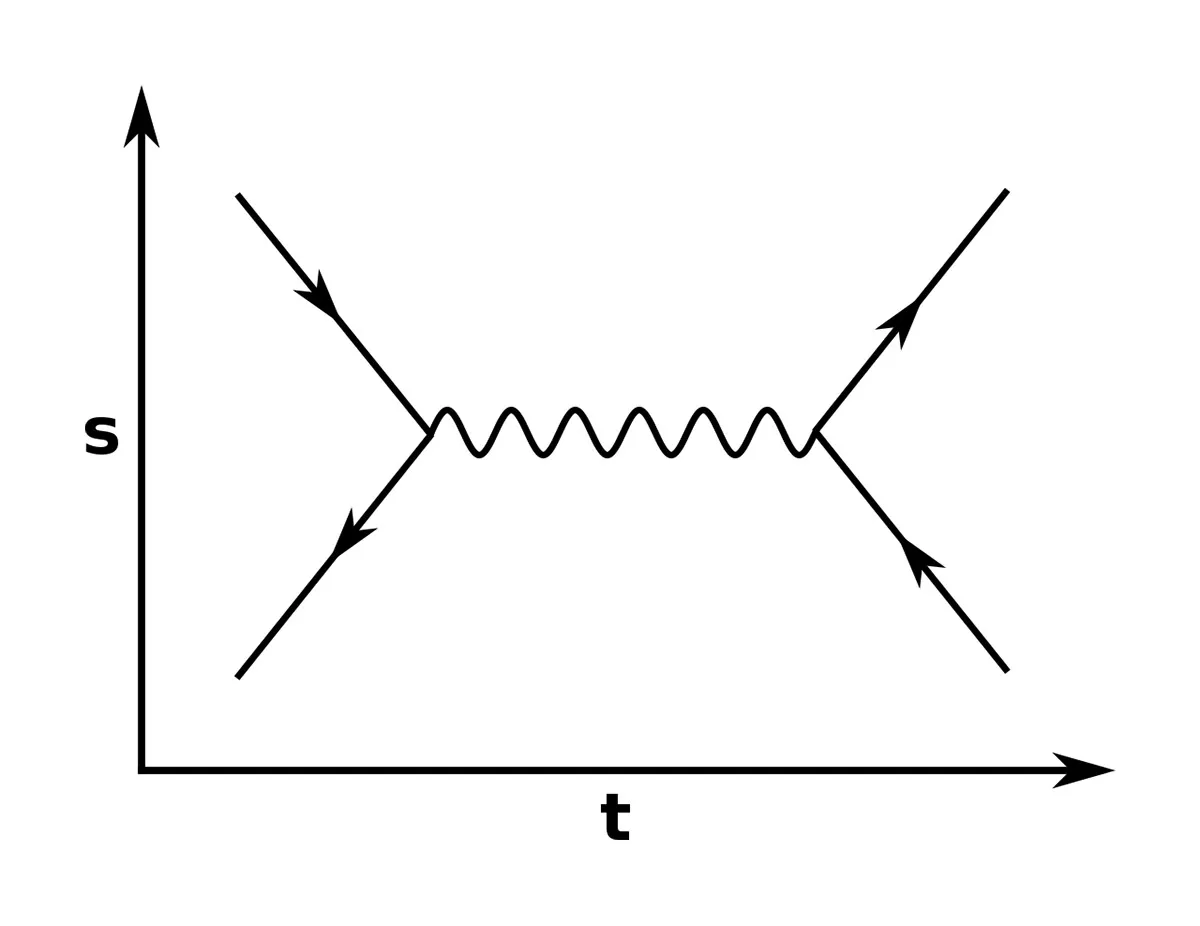
Richard Feynman mapped this grueling math onto pictures. He introduced what we now call a Feynman Diagram, a pictorial representation of the mathematical expressions describing the behavior and interaction of subatomic particles.
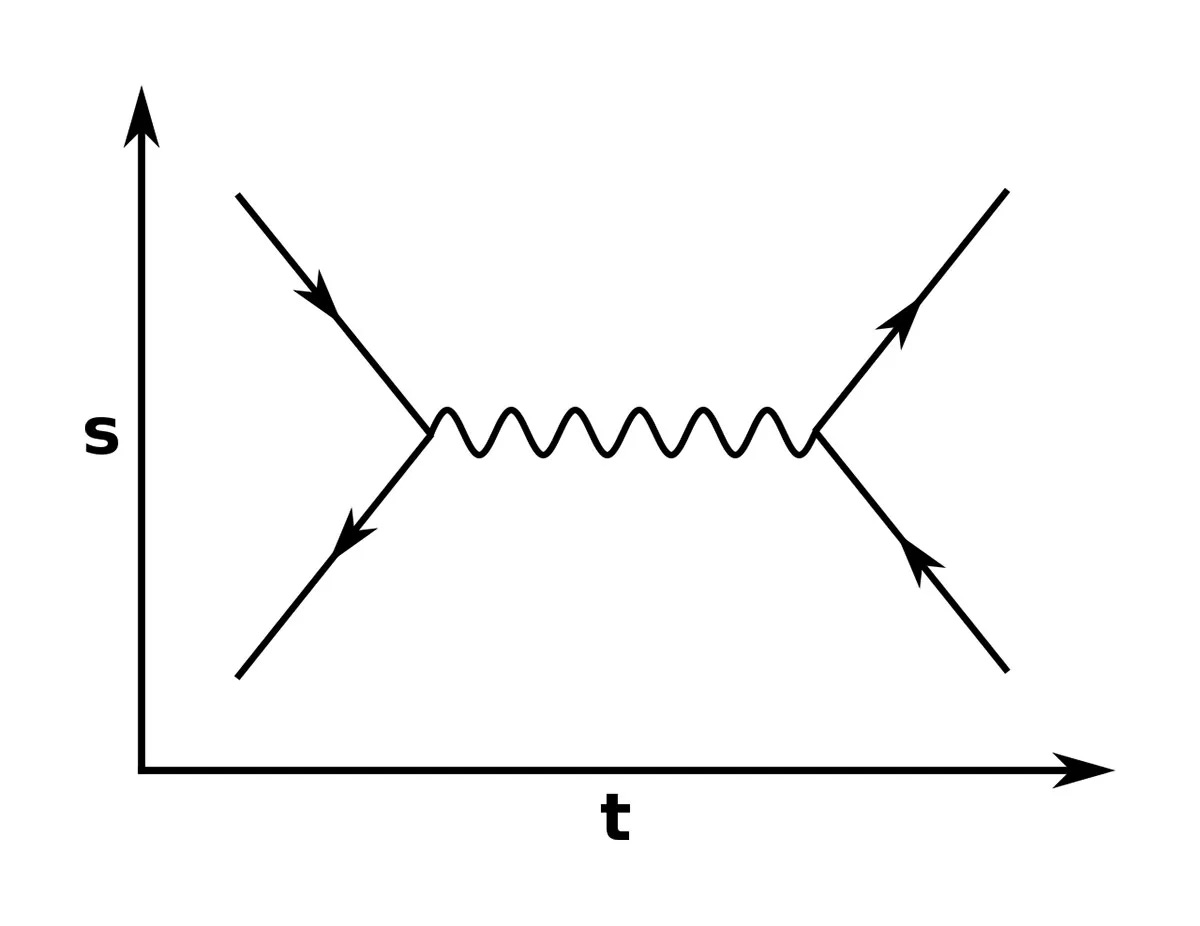
We will discuss them in detail in the next article.
Coupling Constants
If fields are everywhere and always overlapping, why don’t they constantly interact? Because overlap alone is not enough. What matters is how strongly one field responds to another. That response is controlled by the coupling constant. Every interaction comes with a built-in “volume knob” that sets how much the fields are allowed to affect each other.
For example, electromagnetism is relatively quiet. Its fine-structure constant is small (~1/137), which means that charged particles respond only weakly to the electromagnetic field, so interactions are gentle, orderly, and well separated.
The strong force, on the other hand, has a fine structure constant of 1, i.e., two orders of magnitude greater than the EM force. The coupling is so large that fields respond violently and continuously, leaving no room for isolation.
When the coupling is weak, we use perturbation theory: the idea that the simplest, non-interacting picture is mostly correct, and interactions are small corrections. But when the coupling is strong, this picture collapses. The interaction never shuts up. Individual particles lose their identity, and the system reorganizes into a collective, turbulent soup of energy where “free particles” is no longer the right language at all.
The Philosophy of Redundancy
Gauge symmetry suggests that at the most fundamental level, the universe is built on redundancy. A “gauge” is essentially a way of labeling things. The reality doesn’t change just because you changed the labels.
For example, you can measure distances in meters or kilometers. But there's a rule that maps these two different “gauges” (1 km = 1000 m). Similarly, gauge fields are the rules that allow us the freedom to 'label' our fields however we like without the laws of physics falling apart.
Nature seems to say: “You can label my fields however you want at every point in space. I don’t care. But to make that true, I will create light, magnetism, and nuclear glue to make sure the labels always line up.”
For now, just remember:
Particles are simply “representations” of symmetries. Forces are the “connections” that preserve them.
Next Time…
How do we actually calculate the chaos of these particle conversations?
Join me next Sunday as we decode Feynman Diagrams, the ‘comic strips’ of the subatomic world. We’ll see how a few simple lines and squiggles replace pages of terrifying math to reveal the secret life of virtual particles.