

The Story of the First Superstring Revolution
From Veneziano's Discovery to Quantum Gravity's Musical Solution – A Beginner's Guide to Unifying Physics


In the first article of this series, I talked about the problems that arise when we try to unify quantum mechanics with general relativity and how string theory might provide the resolution. Let’s do the real thing now: begin exploring the technical stuff that leads us right into the heart of string theory.
And as you’ll see, it’s nothing but music.
Preliminaries
Before we begin, here are two key ideas to remember:
In high-energy physics, energy and distance are inversely related. Higher energies probe shorter distance scales, while lower energies correspond to larger ones.
and…
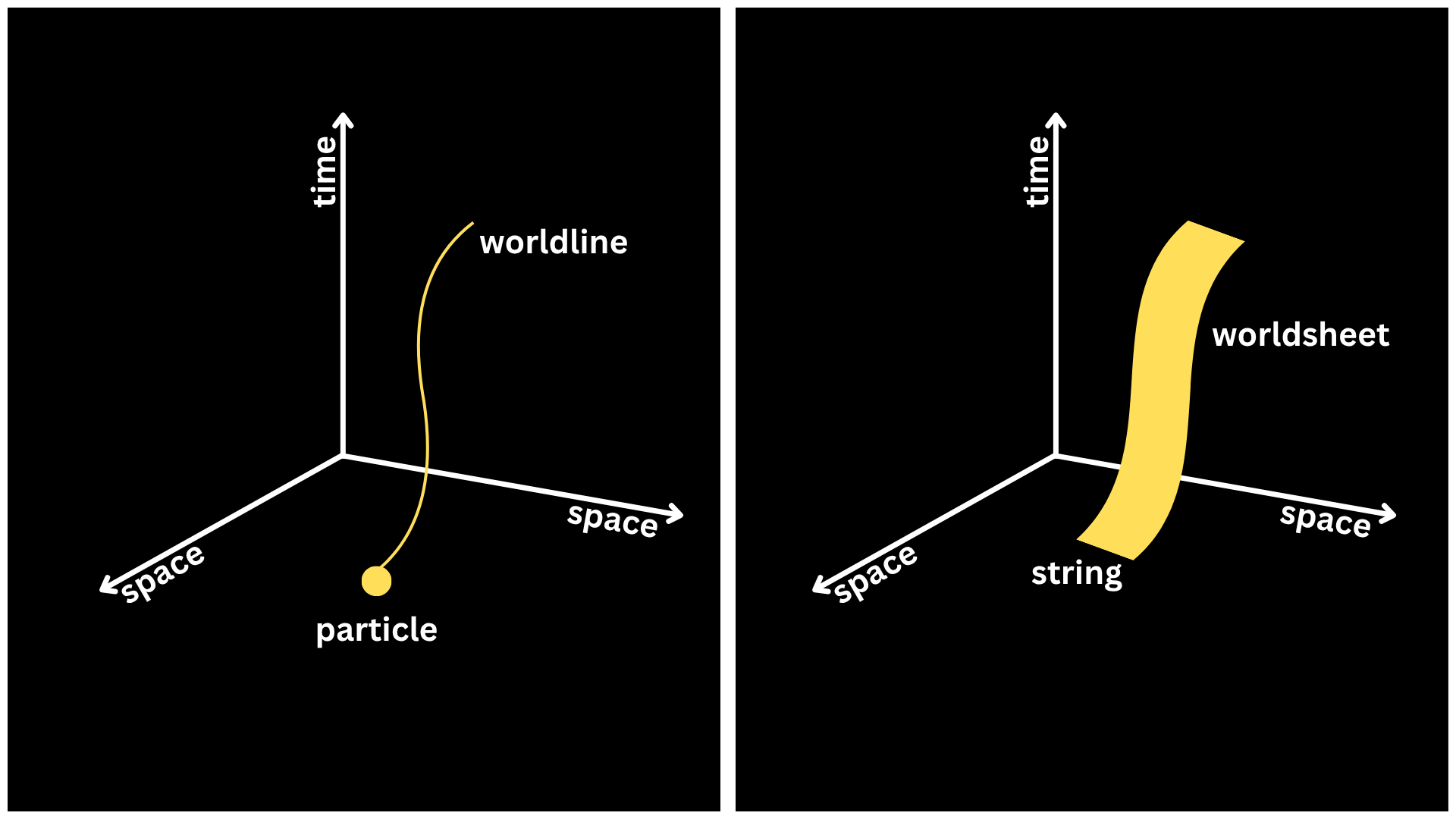
In quantum field theory (QFT), a point particle traveling through spacetime traces out a worldline — a one-dimensional path. But if the fundamental object is a string, its motion sweeps out a two-dimensional surface, or worldsheet.
The Problem with Points
When two point particles interact, they do so at a single mathematical point in spacetime. When we compute probabilities for these interactions, we add up contributions from all possible quantum processes, including those at very short distances (very high energies). Usually, this gives us integrals that diverge (go to infinity). For most forces (like electromagnetism), physicists can renormalize these infinities, essentially absorbing them into a few measurable constants.
But when you try to apply the same logic to gravity, everything breaks down. When we quantize gravity, that is, when we imagine that gravitational effects come in discrete packets (gravitons), we’re effectively saying that spacetime itself fluctuates at quantum scales. Now, if the gravitational field is made of point-like quanta, then every interaction happens at a mathematical point where the energy density becomes infinite. In such a theory, when you compute interaction probabilities (graviton scattering amplitudes), the integrals diverge. The result is a sea of infinite values and no meaningful predictions.

This is why quantum gravity has been so hard; the mathematics of points produces infinities that no renormalization can tame.
From Particles to Strings
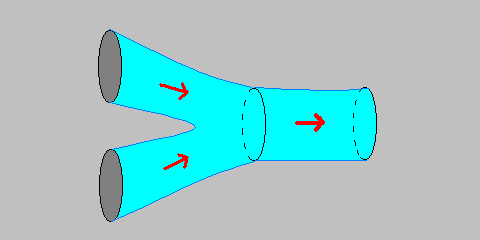
Strings, on the other hand, have a finite size. They can never truly get closer than their own length. So when two strings interact, they don’t meet at a single, infinitely sharp vertex. Instead, they merge smoothly along a finite 2D region of spacetime (called a worldsheet). The string’s spatial extent “smears out” the energy over a small region.
No matter how much energy you pump into a string, beyond the Planck scale, it doesn’t probe finer details — instead, it stretches and grows. When you calculate scattering processes in string theory, the divergent integrals of point theory are replaced with finite, well-behaved ones.
Veneziano’s Amplitude
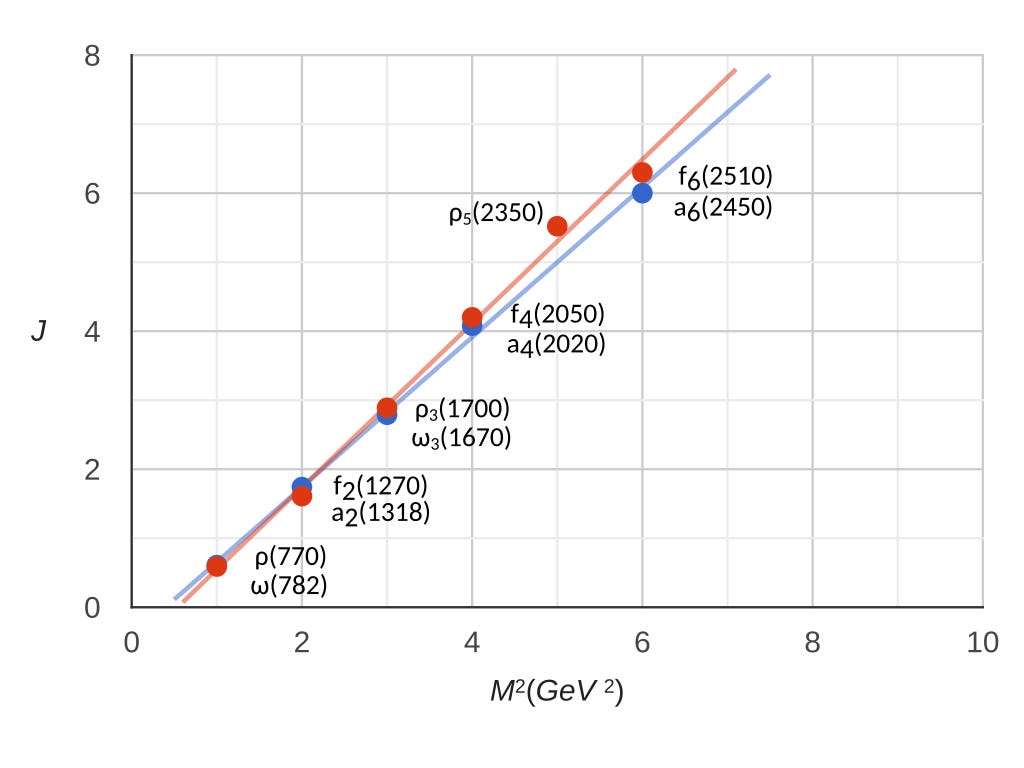
In 1968, when particle accelerators were smashing protons at unprecedented energies, physicists were drowning in a sea of “resonances”: short-lived composite particles that appeared in strong nuclear interactions. These resonances seemed infinite in number, their masses and spins following a curious pattern known as Regge trajectories.
Theorists needed a single formula that could reproduce both:
The tower of resonances (bound states of quarks held by the strong force), and
The scattering amplitudes observed in particle collisions.
That year, Gabriele Veneziano, a young physicist at CERN, made a serendipitous discovery. While searching through mathematical tables, he stumbled upon the Euler beta function, a centuries-old function devised by Leonhard Euler in 1729, that mysteriously described aspects of the strong nuclear force.
Veneziano proposed the expression for the scattering amplitude for two incoming particles (1, 2) producing two outgoing particles (3, 4). It captured experimental data with uncanny accuracy. It had resonance poles — peaks where new composite particles appeared.
Channels of Interaction
Now, in quantum field theory, when two particles collide, you can interpret the process in different “channels.”
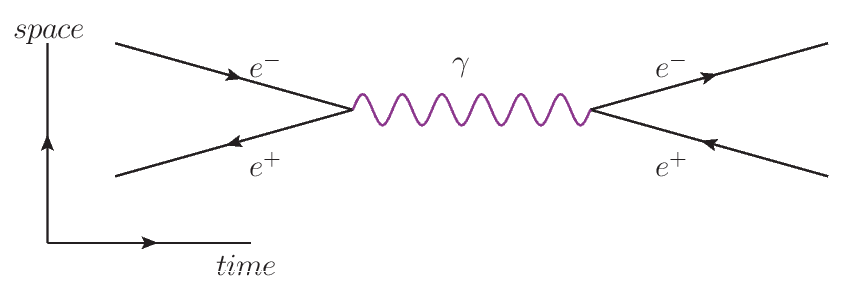
In an s-channel process, two particles collide head-on, annihilate into an intermediate particle (real or virtual), which then decays into the final products – bridging initial and final states like a “handshake”.
In a t-channel process, two particles collide and exchange a virtual particle, which mediates the interaction – like a “high-five”, where the particles pass something between them, connecting the initial and final states sideways.
(I found this brilliant, intuitive explanation on the ATLAS website)
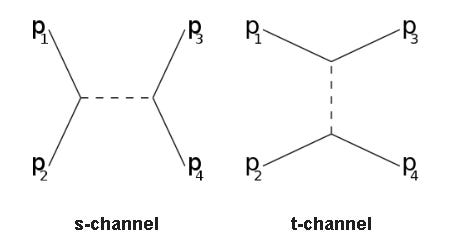
Normally, s and t-channels are distinct physical pictures. But Veneziano’s formula automatically encoded a kind of “duality” between different ways particles could scatter. His amplitude treated them as two sides of the same coin.
This property of duality was revolutionary. It implied that the strong force might not come from point-like quark exchanges, but from something extended that could flexibly account for both pictures at once.
How the Beta Function Emerges from Strings
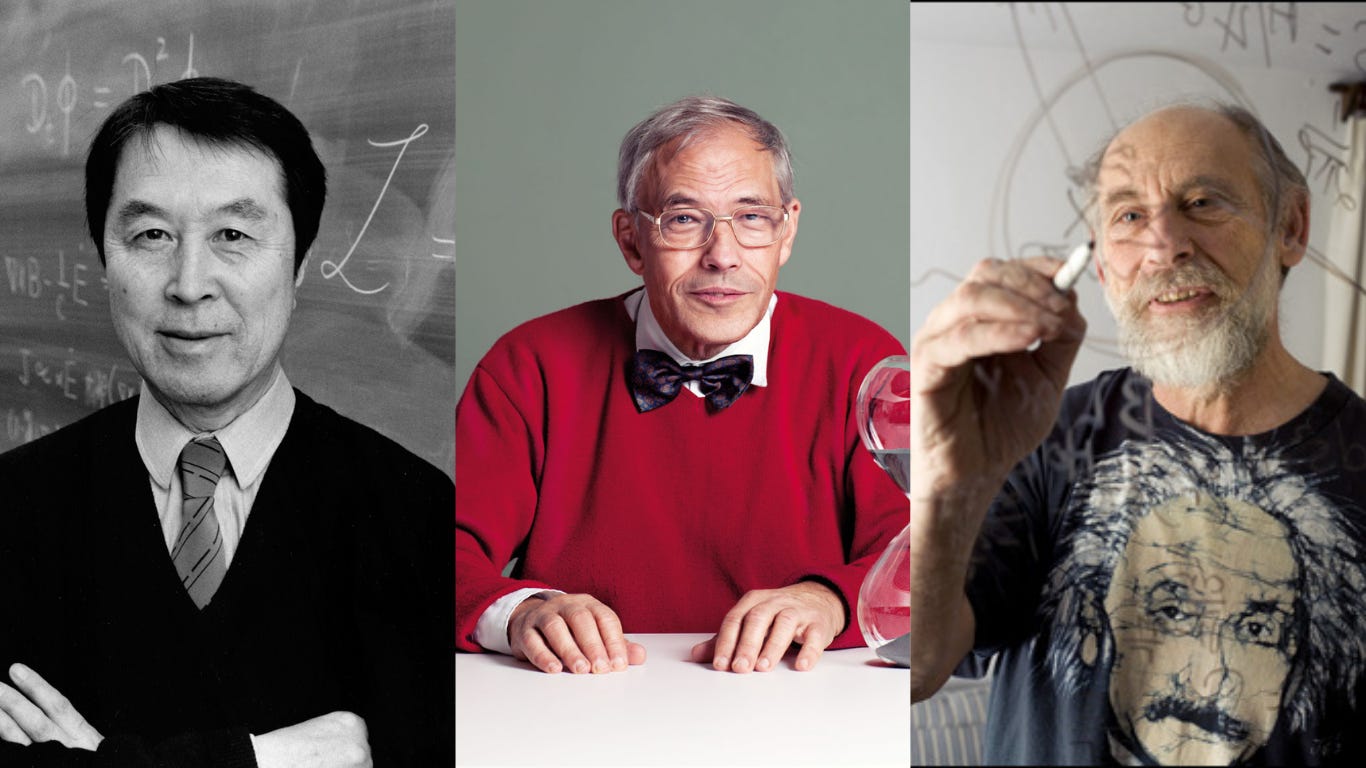
For years, no one knew why the formula worked. Then, in 1970, Yoichiro Nambu, Holger Nielsen, and Leonard Susskind independently uncovered the physics lurking behind Veneziano’s formula. If you model particles as tiny vibrating strings instead of points, the mathematical form of the Veneziano amplitude emerges naturally.
Here’s how it works in essence:
An open string (like a small segment with free ends) can vibrate in many modes, much like a guitar string.
When two strings collide, they can join into one, exchange vibrations, and then split again into two outgoing strings.
The probability amplitude for this process depends on how the worldsheet (a smooth 2D surface) is stretched between the initial and final strings.
Integrating over all possible “shapes” of that worldsheet — while respecting the constraints of relativity and quantum mechanics — gives a term proportional to Euler’s Beta function.
In this picture:
The poles of the Beta function correspond to the resonant vibrational modes of the string (the excited states that appear as different hadrons).
The duality between s and t channels arises because the same worldsheet can be interpreted in two equivalent ways — as one string splitting or as one string joining.
In other words, the Veneziano amplitude is the scattering amplitude for open strings vibrating in spacetime.
Why This Was Revolutionary
The strong nuclear force, with its infinite tower of resonances, looked exactly like the vibrational spectrum of a string under tension. Each resonance (each peak in scattering data) corresponded to a different excited mode of the same string.
This explained why there seemed to be infinitely many strongly interacting particles, each following linear Regge trajectories: they were simply the higher harmonics of a single underlying string. The slope of those trajectories was related to the string tension T and thus encoded the fundamental energy scale of the strong interaction.

Why It Failed as a Theory of the Strong Force
Despite its elegance, early string theory stumbled. When high-energy experiments probed the strong force in the 1970s, they revealed that quarks behaved almost freely at short distances — something string theory couldn’t explain at the time.
Meanwhile, the new quantum chromodynamics (QCD) emerged, accurately describing the strong force as the interaction of quarks via gluons. String theory’s parameters didn’t match QCD’s experimental reality.
But it refused to die because it contained an unexpected ingredient. In 1974, Schwarz and Joël Scherk found that one vibrational mode of the string had no mass and spin 2, precisely the properties expected of a graviton, the quantum carrier of gravity.
Physicists realized the theory could describe not just the strong force, but potentially all forces, including gravity, at the deepest possible scale. This became the theory’s greatest strength. String theory wasn’t just a theory of the strong force — it was a potential “Theory of Everything”, uniting all four fundamental forces.
The First Superstring Revolution
Before 1984, even though string theory hinted at unification, there were still deep mathematical inconsistencies. The main issue was anomaly cancellation; certain quantum inconsistencies (called “gauge anomalies”) threatened to destroy the delicate symmetries that make the theory work.
Then, Michael Green and John Schwarz discovered something remarkable:
In a specific version of superstring theory, all these anomalies cancel perfectly, but only in 10 dimensions. The “smearing out” of energy along a string’s length softens quantum fluctuations.
Their work proved that superstring theory could include gravity and remain mathematically consistent at the quantum level, something no previous theory had achieved. That result electrified the physics community and triggered what became known as the first superstring revolution. For the first time in history, physicists had a finite, anomaly-free, and fully consistent quantum theory that included gravity.

Over the next two years, thousands of papers flooded in, and for the first time, a generation of scientists began to believe they might be standing on the edge of ultimate unification. This was the birth of superstring theory, the physics of a universe made of music.
If you like my work, please subscribe. That +1 keeps me going.
You Can Also Read:
Why do we need Quantum Gravity?

I want to know how God created this world. I am not interested in this or that phenomenon, in the spectrum of this or that element. I want to know His thoughts; the rest are details.