

Quantum Memory, Explained Simply.
The missing link in the quest for a unhackable, super-connected future.

Welcome to Bohring. Here, we look at the universe, life, and science education through a physicist’s lens. If you’re new here, consider joining our community of curious minds:
Note: This article builds directly on my previous deep dive:

Make sure to check it out first to understand the basics of qubits, superposition, the no-cloning theorem, decoherence, and quantum repeaters.
Part 3 in Quantum Technologies
Imagine trying to build the modern internet, but without the hard drive. No flash drives, no cloud storage, no way to save a file for later. If you want to send a message, it has to travel from point A to point B in one uninterrupted go. If a single glitch happens along the way, the data is gone forever. That is exactly where we are stuck right now with the quantum internet.
We have quantum computers that can process mind-boggling data, and we have fiber-optic cables that can carry quantum information. But we are missing the crucial middleman: quantum memory. We don’t have a reliable way to hit pause, store that fragile data, and read it back out when we are ready.
In this article, I will explain why this is so hard to build and why scientists are spending billions to figure it out. Let’s begin by looking at how we got here.
How does normal memory work?
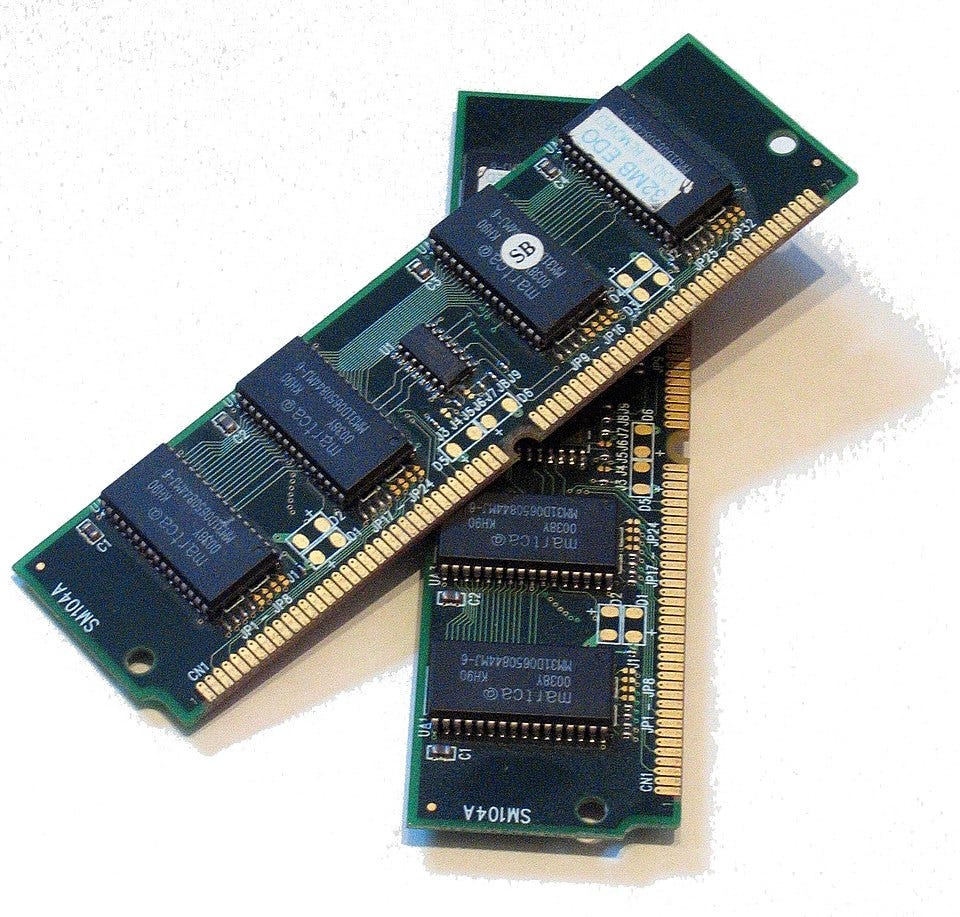
Your phone or computer stores data using classical memory—a massive grid of tiny binary switches that can toggle between bits 0 and 1. Any form of data—photos, emails, and video games—is just billions of these switches flipped into specific patterns. Storing them is easy. You trap some electrical charge in a tiny pocket of silicon, and it stays there until you change it. It’s stable and predictable.
What is Quantum Memory?
Quantum memory is a device or system that stores qubits while preserving quantum properties such as superposition and entanglement. Unlike classical memory, it must maintain the coherence of the stored quantum state so that it can later be retrieved and manipulated without losing its quantum information.
Key performance metrics include:
Storage time (coherence time): How long the device can hold onto a qubit before environmental noise destroys its quantum properties.
Storage and retrieval efficiency: The probability or percentage of successfully catching an incoming photon and getting it back out on demand without losing it.
Fidelity: A percentage score of how accurately the retrieved quantum state matches the original state that was put in.
It’s essentially a temporary ‘hard drive’ for extremely delicate quantum information.
Why do we need it?
Quantum memory is vital because quantum information is too fragile to move or use effectively without a way to safely store it, enabling quantum networks and more powerful quantum computers.
Right now, quantum memory can only hold data for fractions of a second. It sounds useless, but in the quantum world, a millisecond is a lifetime. If we can stretch that storage time to seconds or minutes, it will change everything. It will unlock three major breakthroughs:
1. Quantum Internet
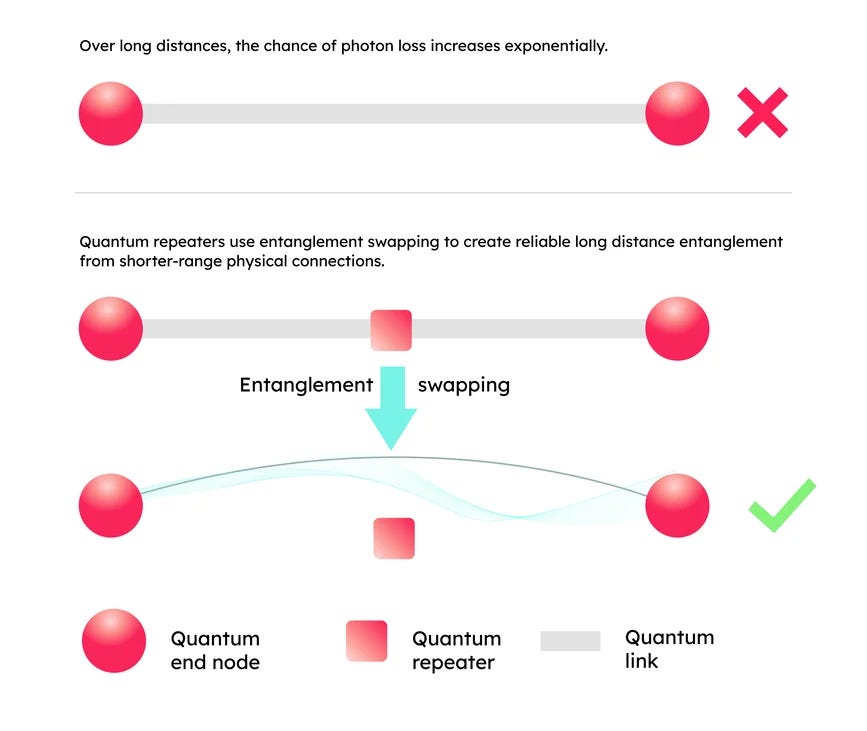
Light fades as it travels down a fiber-optic cable. Regular internet cables use amplifiers to boost the signal every few miles. But you cannot amplify a quantum signal without destroying its superposition.
This is why we are building quantum repeaters. It is the only way to build a global, unhackable quantum network. For long-distance quantum communication (e.g., quantum internet), quantum memories are essential to store entangled photons until the necessary classical signaling can be completed, thus mitigating photon loss over long fibers.
2. Synchronization & Scalable Quantum Computing
Deep inside a quantum computer, different parts need to work together. If one section finishes a calculation early, it needs a place to store that result safely while it waits for the rest of the computer to catch up. Quantum memory acts as the ultimate clipboard.
They can act as buffers for synchronization between different processing units, facilitate error correction codes by holding qubits while others are processed, or store intermediate computation results.
3. Distributed Quantum Networks
It allows us to store entangled states so we can distribute entanglement between distant nodes on-demand.
How does it work?
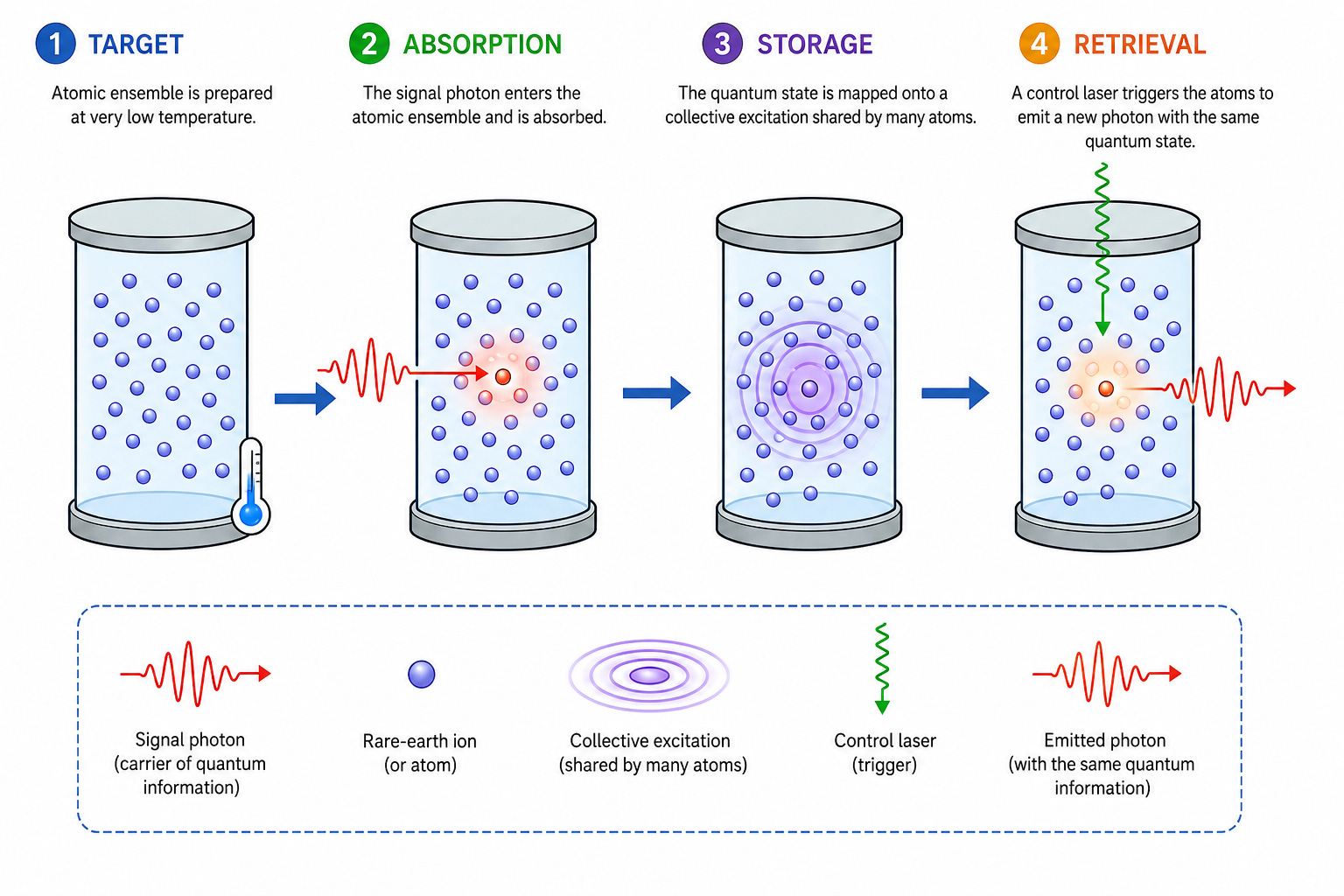
To build a quantum memory device, scientists usually start with a photon. Light is great for carrying quantum data over long distances through fiber-optic cables. But you can’t exactly park light in a garage (it races through at 186,000 miles/sec—the speed of light!). To create memory, scientists have to transfer that quantum state from the fast-moving photon into something that can sit still.
Here is how it works:
Target: Scientists begin with a material such as a crystal doped with rare-earth ions or a cloud of ultracold atoms. The system is cooled to temperatures close to absolute zero so that thermal motion doesn't disturb the fragile quantum state.
Absorption: They fire the signal photon (carrying the quantum data) into this atomic cloud.
Storage: Instead of simply bouncing off, the photon's quantum state is mapped onto a collective excitation of many atoms, rather like a wave spreading across a pond. No single atom stores the information; it is shared collectively across the entire ensemble.
Retrieval: When scientists want to retrieve the information, they shine a carefully timed control laser onto the atomic cloud. This causes the atoms to collectively emit a new photon that carries the same quantum state as the original.
Bohring is entirely reader-supported. The deep-dive physics series and philosophical essays are made possible by the “Deep Divers”—the paid community members who value independent science communication.
If you’re currently on the free tier, consider upgrading to a paid subscription to unlock exclusive deep dives, archives, and chat:
Why is it so difficult to make?
The main challenges in realizing practical quantum memory revolve around the inherent fragility of quantum states and the demands for high performance:
Interaction with environmental noise (e.g., thermal fluctuations, electromagnetic fields) that causes quantum states to lose their coherence rapidly. This is the biggest challenge as it limits the storage time.
We need an efficient way to transfer quantum states from a ‘flying’ qubit (e.g., photon) to a ‘stationary’ memory qubit, and vice versa, without introducing errors. This requires precise control over quantum light-matter interaction.
Next, we need to maximize the probability that a stored quantum state is successfully retrieved at precisely controlled times. The timing is essential for synchronization in quantum networks and computations.
Finally, we want to develop quantum memories that can store multiple qubits and integrate them into larger quantum systems without significant performance degradation.
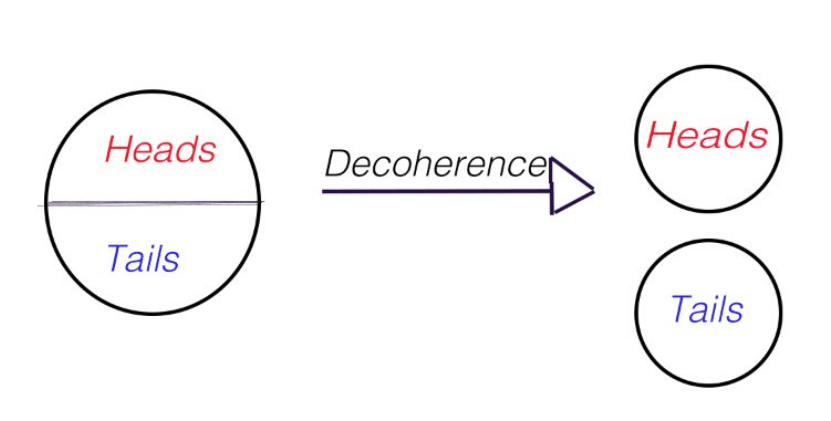
Today’s quantum memory setups are bulky, require extreme refrigeration, and are highly inefficient—often losing the photon entirely during the process. But the progress is real. Every month, researchers are finding new materials and techniques to keep the quantum coin spinning for just a little bit longer.
Thank you for reading. If my reflections on life or physics resonated with you today and you’d like to support my independent writing without committing to a monthly subscription, you can drop a small tip in my digital jar. It keeps me motivated.
You Can Also Read:


Thank you!!