

What is Renormalization in Quantum Field Theory?
The universe reveals itself depending on how close you look

Article #11 in the Quantum Field Theory series.
Pro Tip: Listening to music at an optimum volume makes reading much more enjoyable!
In the early days of Quantum Field Theory (QFT), the pioneers like Dirac, Pauli, and Heisenberg were puzzled by the divergent integrals that they often encountered in their calculations. When they attempted to calculate something as simple as the mass of an electron or the way it repels another electron, the math would yield infinities. They spent much of the 1930s and 1940s struggling with them.

For a while, it looked like QFT was doomed. But the fix for these infinities, a process called Renormalization, turned out to be the deepest insight into the structure of reality we’ve ever had.
The Disaster of the Point Particle
To understand why QFT breaks, we have to look at the behavior of the universe at the shortest of scales.
In classical physics, we consider an electron a point particle. But a point has no volume. If you have a certain amount of electric charge packed into a point of zero size, the charge density becomes infinite. More importantly, the electric field surrounding that point gets stronger and stronger the closer you get.
The mass-energy of the electron field is given by:
where mem is the mass of the electron, q is its charge, and r is the radius. As you approach a distance of zero (r → 0), the energy stored in that field becomes infinite. Since E = mc2, an infinite amount of energy means the electron should have an infinite mass.
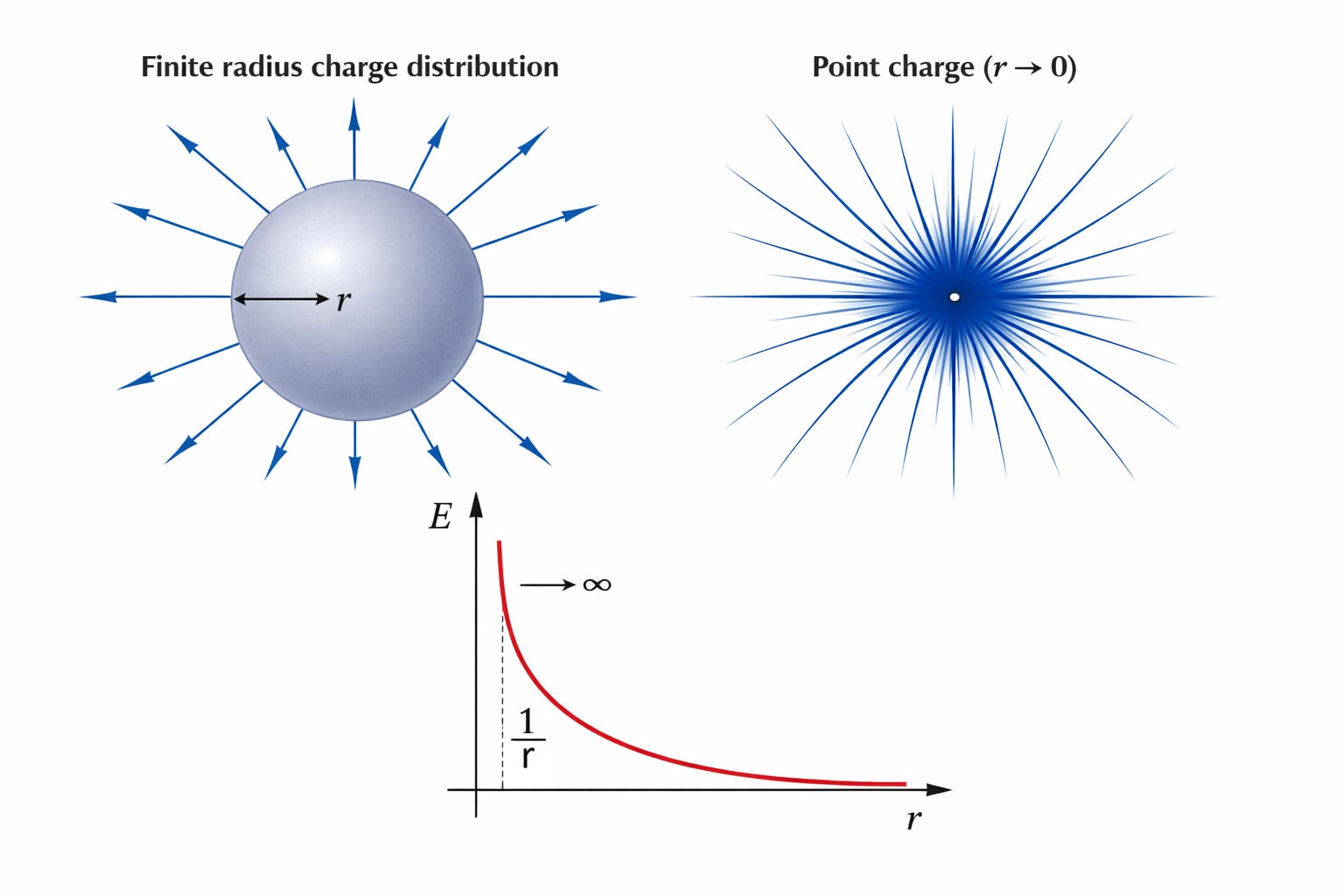
In QFT, the problem gets even noisier. In this article,

I explained why the vacuum is a roiling sea of virtual particles because of the uncertainty principle. And in this article,

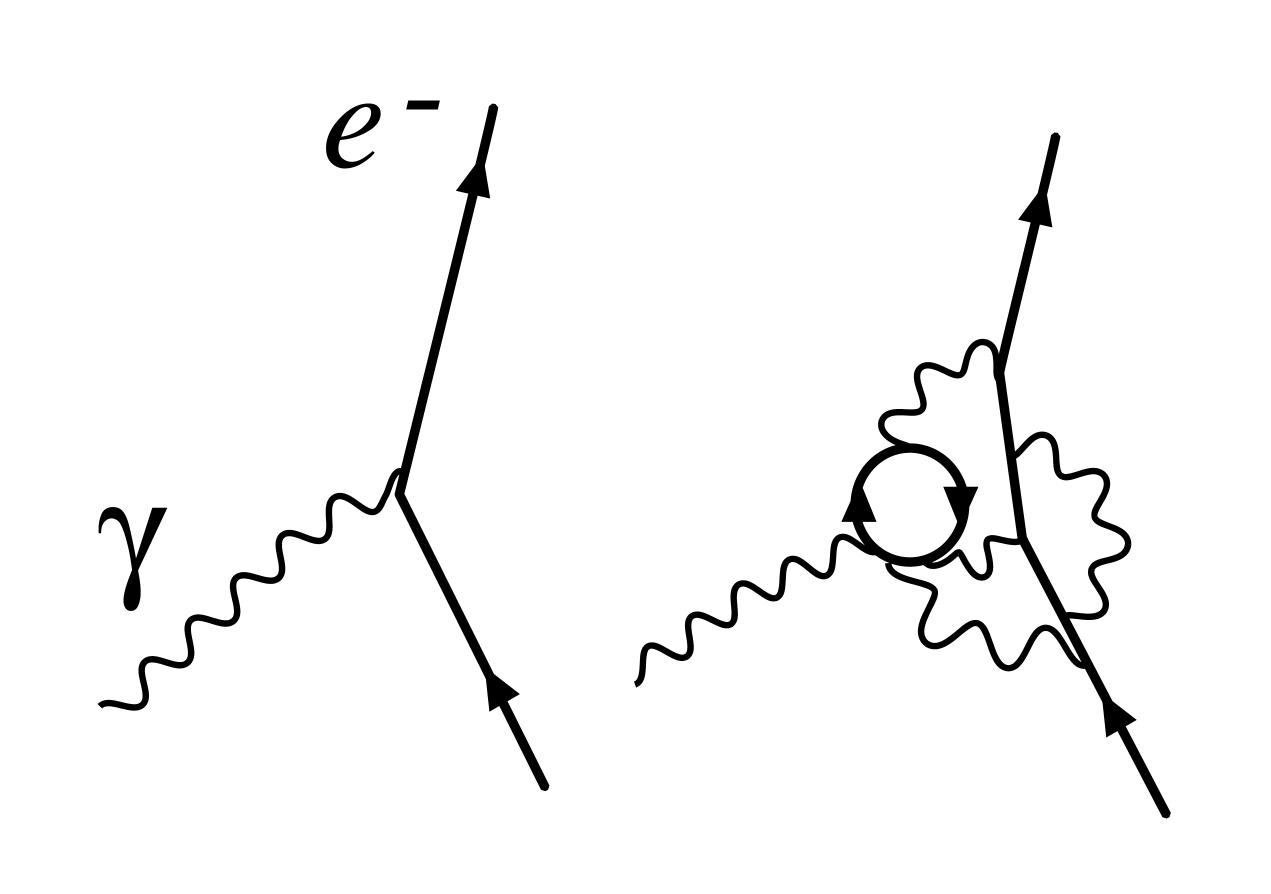
I discussed electron self-energy, which states that an electron is constantly emitting and reabsorbing virtual photons as it propagates through spacetime. Those photons, in turn, can split into virtual electron-positron pairs.
When you try to calculate the effect of all these loops of activity happening at infinitely small scales, the math blows up. Every interaction happens at a point in spacetime, and the sum of all possible high-energy vibrations in the field leads to integrals that diverge (i.e., go to infinity).
The Cutoff: Acknowledging Our Ignorance
The first step the founders took to fix this was a bit of tactical cowardice called Regularization.
Firstly, familiarize yourself with this rule, which I mentioned previously here:

In high-energy physics, energy and distance are inversely related. Higher energies probe shorter distance scales, while lower energies correspond to larger ones.
The math blows up because we are assuming our theory works down to a distance of zero, which means we don’t actually know what happens at that scale. We acknowledge our limitations and introduce a limit called Cutoff. We calculate the effects of field vibrations upto a certain distance or energy and ignore any effects beyond that level.
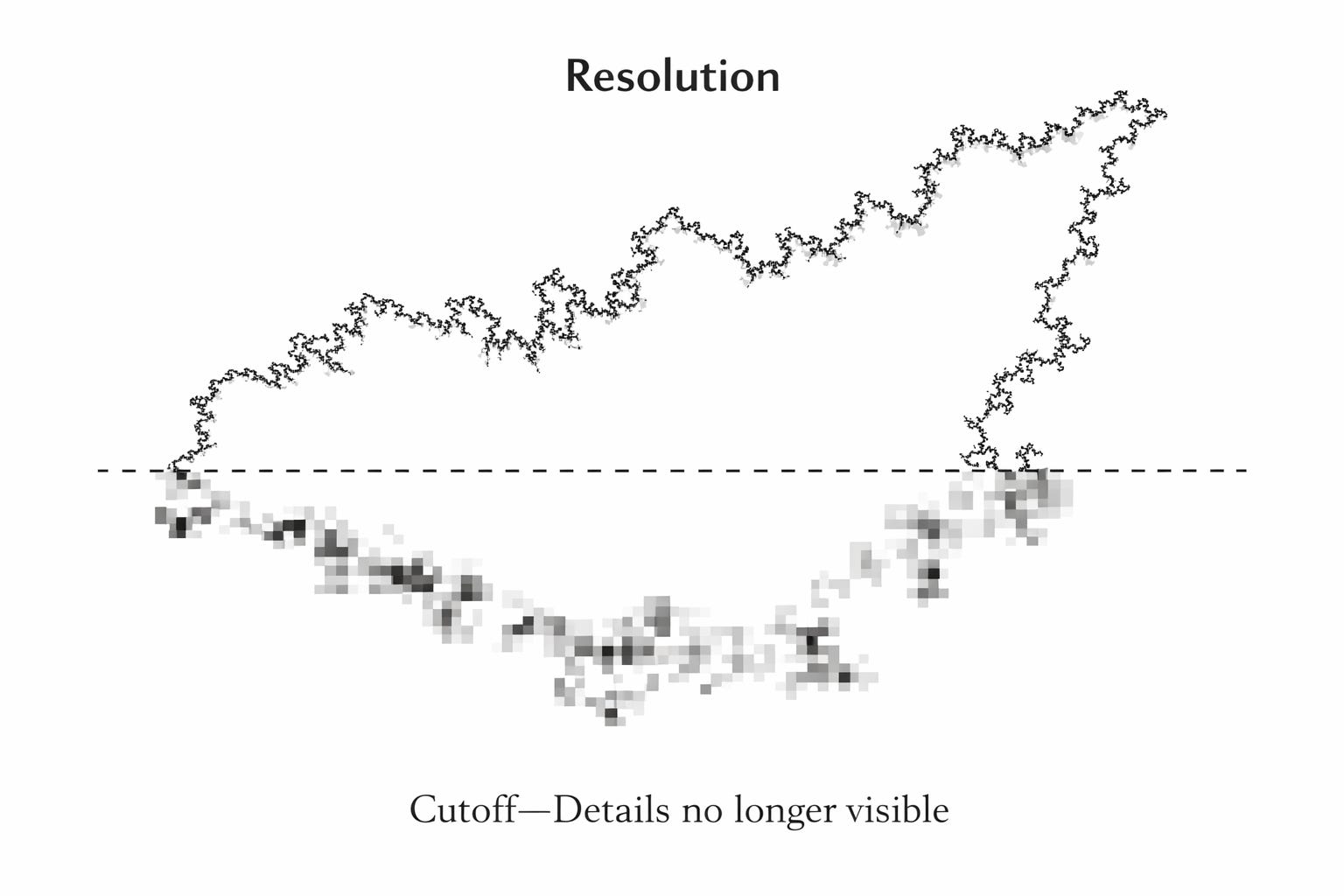

With this limit in place, the infinities become finite. They are still massive, gargantuan numbers, but they aren’t ∞ anymore. However, this leaves a glaring question: If the theory depends on this arbitrary limit, is it even real?
Bare vs Physics Mass
Here is where the genius of Richard Feynman, Julian Schwinger, and Shin’ichirō Tomonaga came in. They realized that we had been asking the wrong question.
We were trying to calculate the “bare” values of mass and charge of the electron, the properties it would have if it were totally isolated from its own field. But a bare particle is a fiction. You can never turn off the field. You can never stop the virtual particles from swarming around it. In the real world, when you measure an electron’s mass in a lab, you are measuring the “physical” mass (mphysical), which is the bare core (m0) plus the energy of the surrounding virtual cloud (𝝳m).
The genius (and the controversy) of renormalization is the assumption that we can tune the bare mass parameter to be infinite and negative to cancel the positive infinity contribution from the field loop corrections. By absorbing divergences into the redefinition of these parameters, their combination comes out to be a finite, measurable value, the Physical Mass, which we see in our experiments (0.511 MeV).
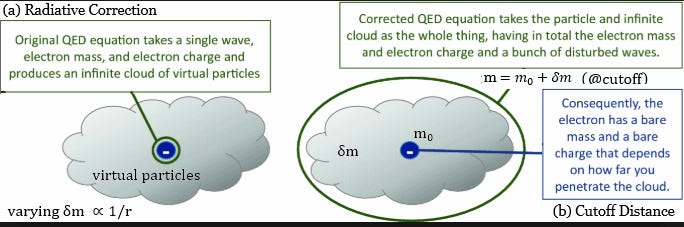
While this feels like sweeping dirt under a rug, it worked perfectly. The predictions matched experiments to more than ten decimal places. It’s a way of recalibrating our instruments. We define our theory based on what we actually see at our energy scales, rather than what bare entities might exist in the unreachable void of zero distance.
Running Couplings
If renormalization were just about canceling infinities, it would be a footnote. But it revealed something weirder: several constants we encounter in particle physics, like the charge and mass of an electron, aren’t actually constant. They run.
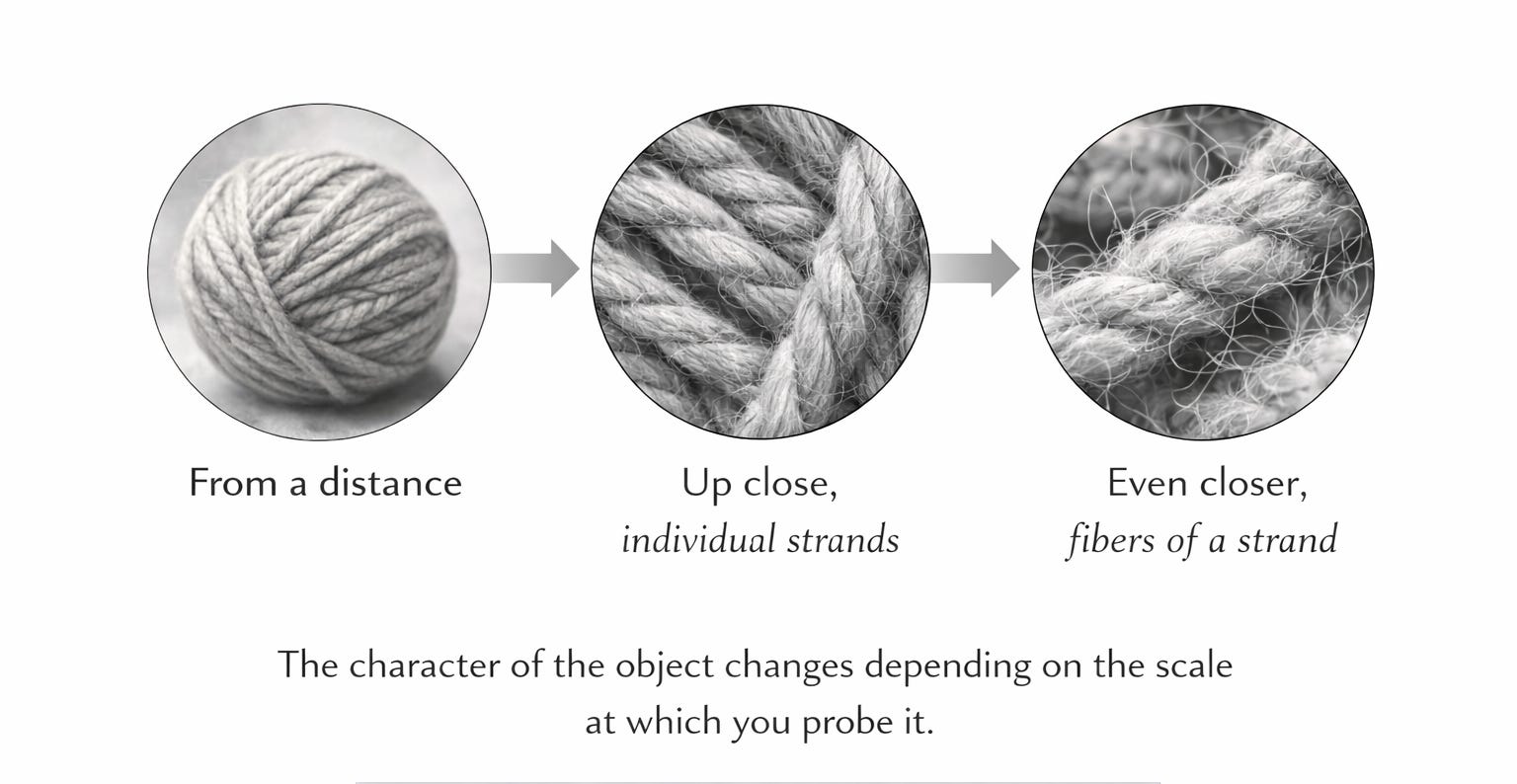
Think of a ball of wool. From a distance, it looks like a smooth, solid sphere. As you get closer, you see the individual strands. Closer still, you see the fibers of each strand. The character of the object changes depending on the scale at which you probe it.
Similarly, in Quantum Electrodynamics (QED), the vacuum acts like a polarized medium (Vacuum Polarization). The virtual electron-positron pairs in the vacuum screen the electron’s charge. The positrons are attracted to the electron, and the electrons are repelled. From far away, you see the electron through this thick mist of virtual particles that shield its true strength. The electron’s charge looks weaker as a result.
If you want to see the true charge, you have to blast a probe through that cloud with high energy. Then you see more of the raw, naked electron, and the value of its charge appears to increase. Therefore,
The strength of the force depends on the energy of the interaction.
This is why in Electromagnetism, the force gets stronger as you get closer. In the Strong Nuclear Force (QCD), the opposite happens. The force gets weaker as you get closer, a phenomenon called Asymptotic Freedom.
The Layers of Reality
I like to think of renormalization as organized ignorance.
Infinities are just nature’s way of saying “your model is incomplete.” They arise when we try to see all scales at once. Renormalization is our admission that we don’t know everything yet. It forces us to define our parameters by what we can actually observe. The result is an incredibly robust universe, where the laws of physics at our scale remain stable even while the chaos of the quantum foam rages beneath.
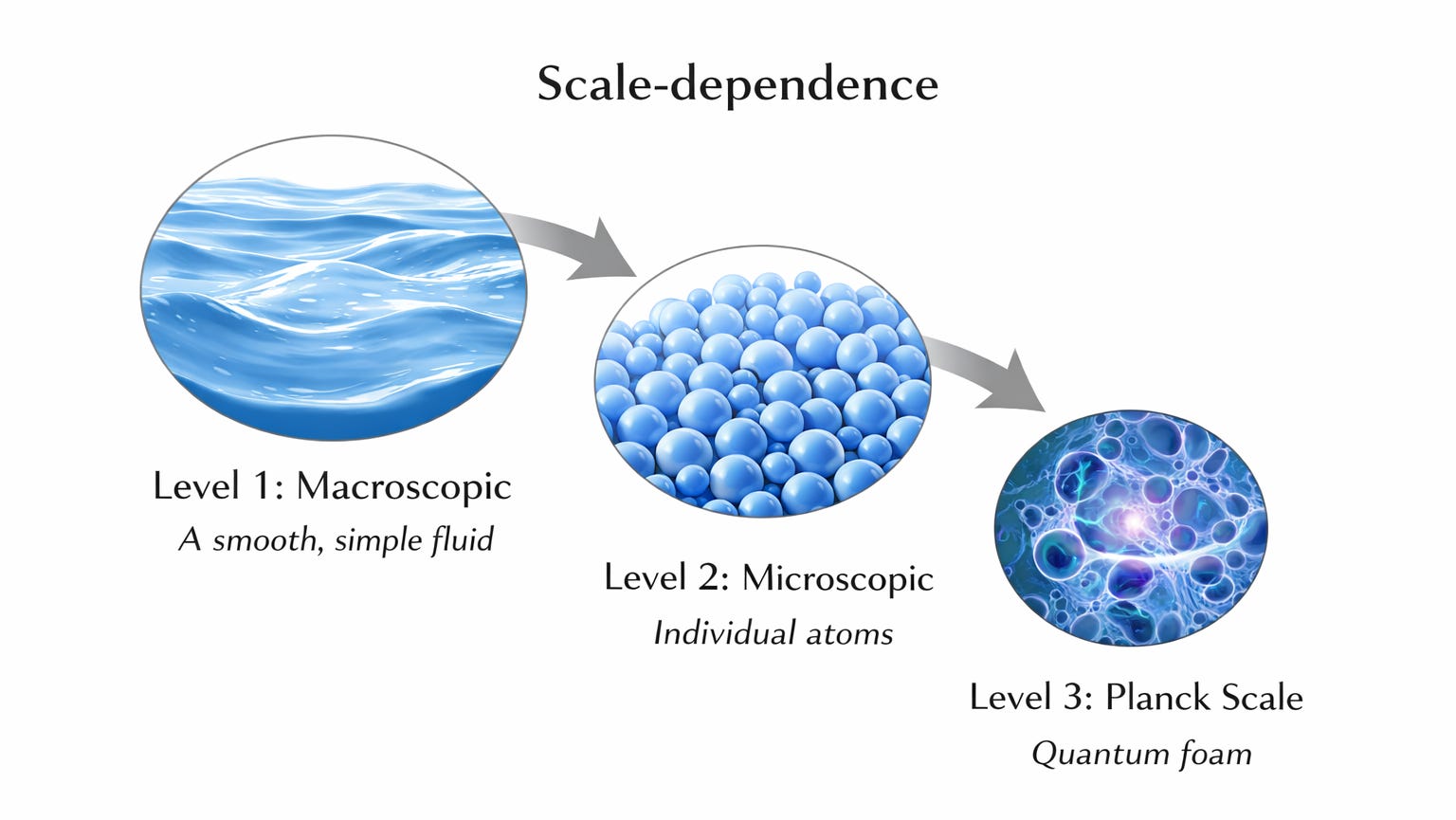
For now, remember that physics is scale-dependent.
Next Time…
Any discussion on renormalization can’t be complete without talking about Effective Field Theory. But I don’t want to condense this brilliant idea into one or two paragraphs. It deserves a detailed article of its own. So that’s where we are headed next Sunday. But…
Isn’t it amazing I can explain such complex topics with visual analogies!



fun fact: this whole thing about the mass-energy of the electron was basically what made people find out about the mass energy equivalence in the first place, they notices that if the EM field has momentum, effectively for a force to push a charge it needs to push the charged body *and* the electromagnetic field, making it have an effectively larger mass
it even lead to theories that all mass was actually this effective electromagnetic mass, aka that everything is charges with 0 bare mass but which have an effective mass given by the electromagnetic field (which has a big higgs field vibe tbh that's basically kinda how modern physics works)
Quite insightful. I think this “Renormalization” term can be used in the concept of god as well. Accepting that we don’t know everything and that is fine. We need not give definitions to something that we are not sure of, and acknowledge that. Cheers